There are no silver bullets. No ‘one right answer’ for every situation. Best practices are always past practices from another place and time, with different conditions. To be successful in our conditions today requires better strategic thinking. How do we do this?
So how do we do this?
Imagine, for a moment, that you’re lost in a foreign city where you don’t speak the local language. What would you do? You’d open a map on your phone, find your current position, where you want to get to and your options for movement. Then set off in the right direction, checking your progress along the way.
In an unfamiliar terrain a map is an almost magical tool. So why don’t we use them in business?
Wardley Mapping AI
For most businesses, AI is like a foreign city where we don’t speak the local language. Failing to act means staying lost. But making false steps could take us in the wrong direction, leading into dangerous terrain.
In this unfamiliar landscape, we need a map to find our way.
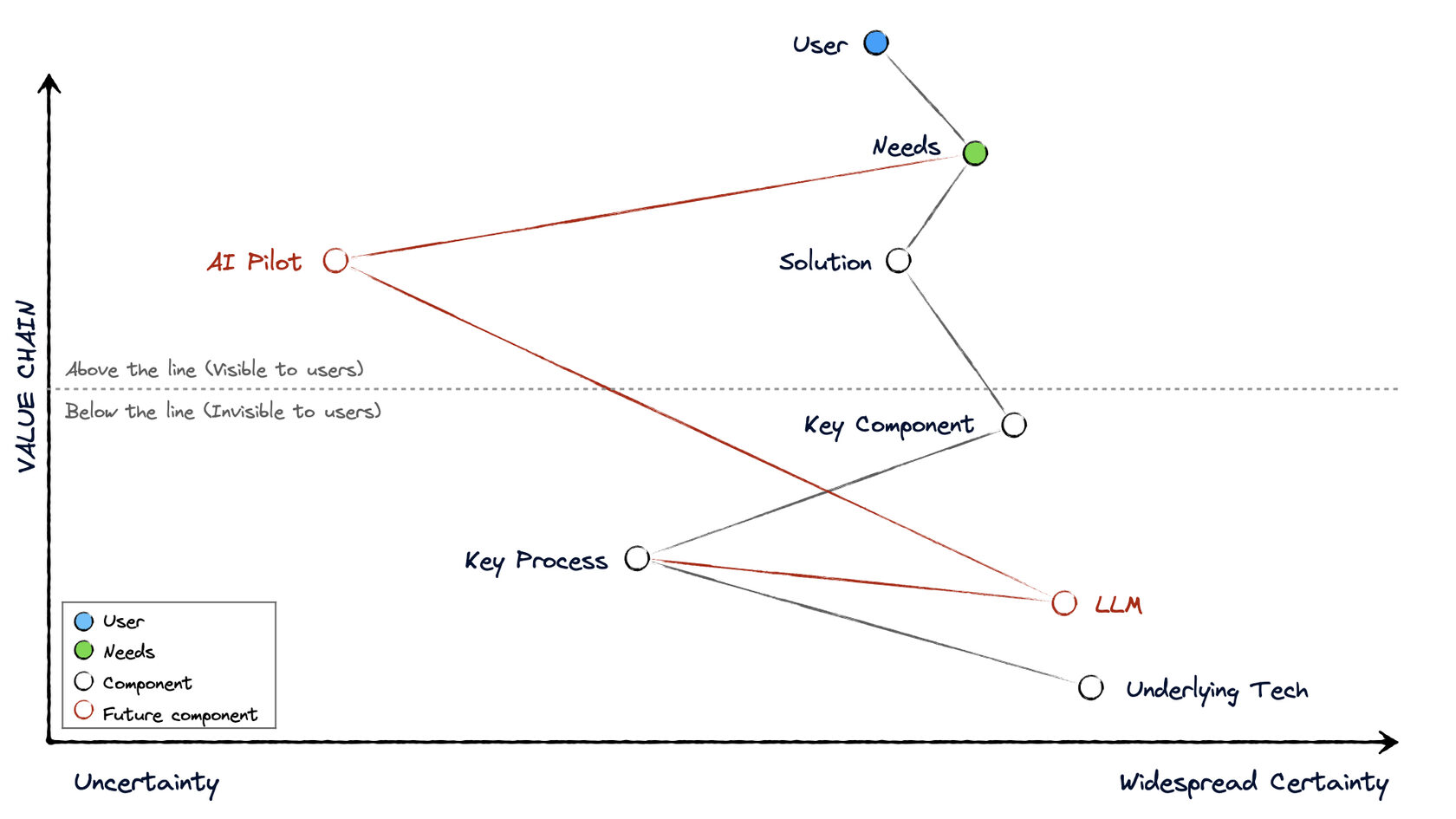
The simple Wardley Map (attached) has a vertical axis, showing the components we deploy to satisfy user needs and create value. The horizontal axis shows how much certainty — or lack of it — we have about each component. The question we will use this map to answer is: what moves should we be making with AI?
Discussions such as these are taking place across industries worldwide today. Yet, few do so with a map — trying to find their way blindfolded with no awareness of their landscape or how it’s changing — hoping that their next moves are the right ones. But with a map we can get that all-important context:
With a map of our landscape we can clearly see our options for action and where the uncertainty is. Now we can make choices appropriate for us — those that align with the amount of risk we’re prepared to take on — rather than blindly following others, hoping it’s not leading us off a cliff.
Quick Test
In your next discussion about AI, ask colleagues where you should be a first mover and where you should be a fast follower and why.
If they can’t answer, then it’s time to get a map.
What Next?
Identifying better moves.
To follow this series join the Telegram channel t.me/wardleymapping
Or subscribe to the blog https://powermaps.net/blog
If you found this post useful consider sharing it with others.
And if you’d like to think and act strategically in your organisation explore more here: https://powermaps.net
So how do we do this?
Imagine, for a moment, that you’re lost in a foreign city where you don’t speak the local language. What would you do? You’d open a map on your phone, find your current position, where you want to get to and your options for movement. Then set off in the right direction, checking your progress along the way.
In an unfamiliar terrain a map is an almost magical tool. So why don’t we use them in business?
Wardley Mapping AI
For most businesses, AI is like a foreign city where we don’t speak the local language. Failing to act means staying lost. But making false steps could take us in the wrong direction, leading into dangerous terrain.
In this unfamiliar landscape, we need a map to find our way.
The simple Wardley Map (attached) has a vertical axis, showing the components we deploy to satisfy user needs and create value. The horizontal axis shows how much certainty — or lack of it — we have about each component. The question we will use this map to answer is: what moves should we be making with AI?
- Should we focus on AI ‘above the line’ — replacing existing solutions with AI pilots that are cheaper for us to provide?
- Or, should we focus on using AI ‘below the line’ — using AI as infrastructure to improve the reliability of underlying components by connecting with an LLM?
Discussions such as these are taking place across industries worldwide today. Yet, few do so with a map — trying to find their way blindfolded with no awareness of their landscape or how it’s changing — hoping that their next moves are the right ones. But with a map we can get that all-important context:
- The AI pilot is on the left of the map, meaning it’s full of uncertainty. We should tread carefully here — perhaps being a fast follower, waiting for AI pilots to become more reliable first.
- The LLM is on the right, meaning there’s a high degree of certainty about it. We now know the direction the market is heading — so can we gain an advantage over rivals by being a first mover.
With a map of our landscape we can clearly see our options for action and where the uncertainty is. Now we can make choices appropriate for us — those that align with the amount of risk we’re prepared to take on — rather than blindly following others, hoping it’s not leading us off a cliff.
Quick Test
In your next discussion about AI, ask colleagues where you should be a first mover and where you should be a fast follower and why.
If they can’t answer, then it’s time to get a map.
What Next?
Identifying better moves.
To follow this series join the Telegram channel t.me/wardleymapping
Or subscribe to the blog https://powermaps.net/blog
If you found this post useful consider sharing it with others.
And if you’d like to think and act strategically in your organisation explore more here: https://powermaps.net