When you're in unfamiliar territory and need to decide what steps to take next, it's helpful to have a way of visualising the space you’re in. If you’re in a foreign city you use a map to see where you are and where you want to get to. That’s because a 'picture is worth a thousand words' — it allows you to scan an entire landscape quickly (“where are we?”), compare options (“is this way faster or that?”) and check progress as you go (“if we're heading in the right direction we should see a river soon”).
Navigating an unfamiliar AI landscape is similar. You could find your way by following the crowd — copying what others are doing — but that could get you even more lost. Or you could use a Wardley Map — an open-source approach used by leading organisations globally to see how their business landscapes are changing and where their options for action are.
A Wardley Map consists of two parts:
- A Value Chain — showing the assets (components) you use to create value.
- Evolution — showing how evolved components are so you know how to manage them.
This post will focus on the Value Chain.
Value Chain for AI Deployment
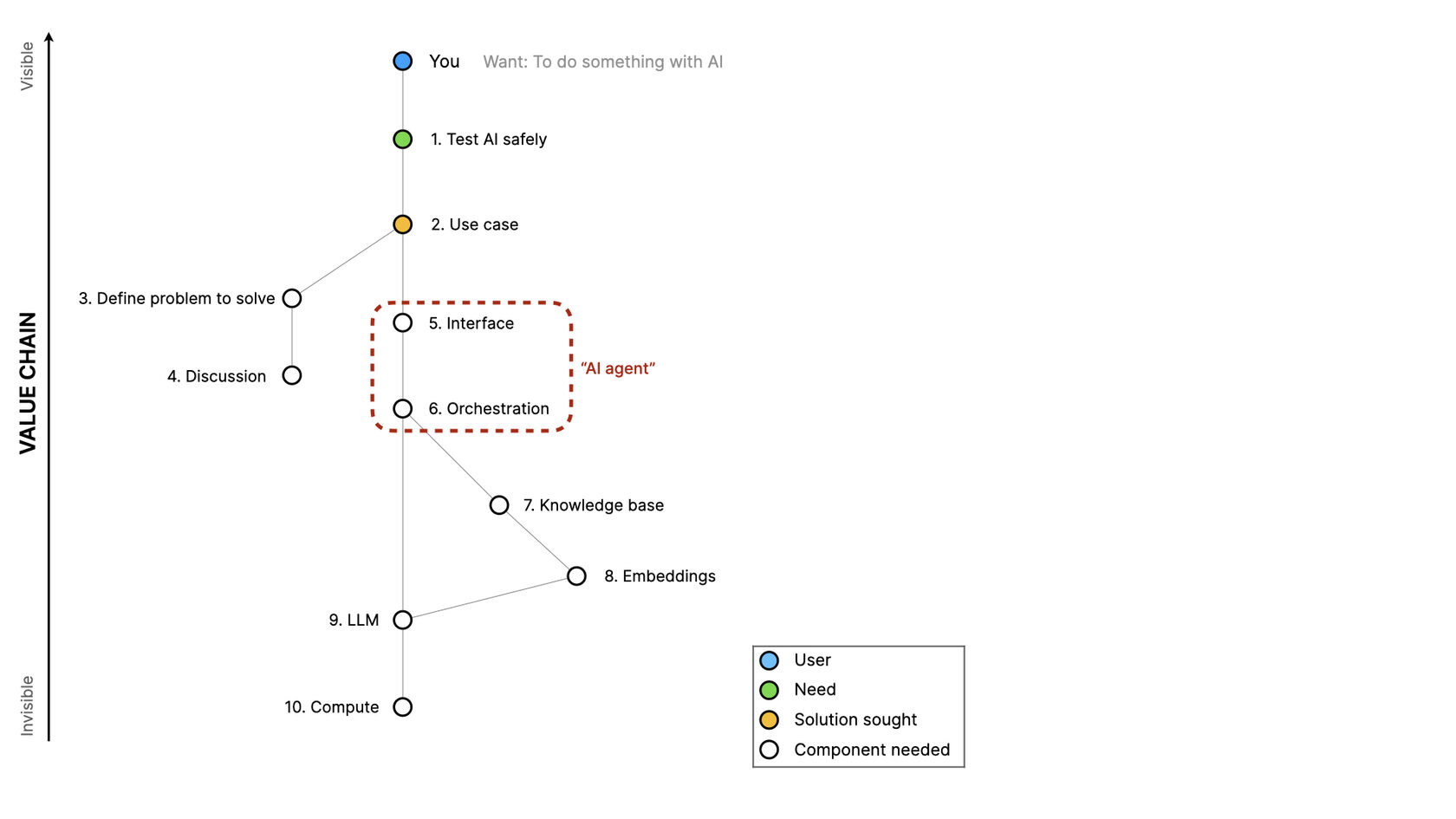
The User
A business creates value by satisfying the needs of users who are important to them: clients, employees and shareholders. For this example, I’m going to take YOU as my user.
You are under pressure to “do something with AI”. You don’t know what to do yet — and that’s what I’m going to help you figure out.
You are under pressure to “do something with AI”. You don’t know what to do yet — and that’s what I’m going to help you figure out.
I place you at the top. You are my North Star. Everything I will do is to satisfy your needs. If I do this successfully you will satisfy my need for revenue generation.
User Needs
Now the hard part. I have to take your perspective to identify what you think you need. I need to be careful not to confuse my needs (to sell something) with yours. You don’t care about my needs — you only care about your own.
You need to test AI safely before committing further resources. So I’m going to add ‘Test AI safely’ (1) as your main need.
Solutions
To satisfy your needs I have to provide solutions. But you have a choice between my offerings and those of my rivals. I can’t just push my solutions onto you — I have to think about what you’re looking to pull into your life.
‘Testing AI safely’ starts with choosing a 'use case’ (2) — a specific task you want the AI to do. This will help you decide if AI is useful here.
Most visible components
A ‘Use case’ depends on two things. First, you need to ‘Define a problem to solve’ (3) — something you care about solving. This will require a ‘Discussion’ (4) with decision-makers to identify a problem that’s highly visible and meaningful to you.
Second, it requires an ‘Interface’ (5) — something you will actually interact with, like a chat window. This is what you will see as AI.
‘Back of house’ components
AI’s real work takes place under the ‘Interface’ at the ‘Orchestration’ (6) layer. When you enter a request, orchestration takes it and finds relevant context (prior conversations, documents, user data). It assembles that into a well-formed prompt. It calls the AI model. Then returns a response. Finding context and feeding it into a prompt is what people mean by RAG (retrieval-augmented generation). Without orchestration, there’s no RAG and no intelligence — just an empty shell.
‘Orchestration’ can’t work without something to retrieve from. That’s the ‘Knowledge base’ (7) — your organisation’s own documents and data, prepared in a way that AI can find and use. This preparation involves creating ‘Embeddings’ (8) — numerical fingerprints. Similar ideas get similar numbers, even when the words used are completely different. This is how AI searches by meaning, not just by keyword.
Foundational components
All the above runs on a foundational model, a ‘Large Language Model (LLM)’ (9) like GPT, Claude, DeepSeek, or YandexGPT. This generates your ‘Embeddings’ and answers every ‘Orchestration’ request.
LLMs require ‘Compute’ (10) — the cloud infrastructure scaling globally to support it all.
AI Agents
"AI agent" is a marketing term. It covers the 'Interface' and 'Orchestration' components with one crucial difference — autonomy. The machine plans and executes multiple steps without being prompted each time.
That means handing decision-making to something that can't be held accountable. But you will still deal with the consequences — making it less safe to test.
That means handing decision-making to something that can't be held accountable. But you will still deal with the consequences — making it less safe to test.
Conclusion
Now you have a Value Chain of this space. You can start to ask the right questions, challenge assumptions, and understand what's being considered.
The next step is to add Evolution to the Value Chain to make a Wardley Map of the AI landscape, so you can see how to move through it. Part two will show you how.
The next step is to add Evolution to the Value Chain to make a Wardley Map of the AI landscape, so you can see how to move through it. Part two will show you how.