Insight is the key to this process … it is the creative element and the drive and will of the mind that conceived them that gives these strategies their extraordinary competitive impact.
— Kenichi Ohmae, The Mind of the Strategist
Insights are sudden and unexpected shifts to better stories1that lead to new courses of action. New courses of action are the foundation of a theory of how to win — in other words, a strategy.
A theory of how to win must be grounded in reality. A theory that treats conditions as we wish them to be, rather than as they are, harms an organisation.
Situational awareness grounds theory in reality. It is understanding how value is created today and where conditions are changing next.
Situational awareness requires:
- Knowing users and focusing on their needs.
- Seeing the position of components in your Value Chains.
- Understanding the potential for movement of these components.
User needs
The purpose of any business is to create and keep a customer. This means a business must start with user needs and work back to the technology, not the other way round.
Know your users
A business has multiple users: external users, such as customers, suppliers, even wider society; and internal users, such as employees, leaders, and owners. To be successful, a business must satisfy all users’ needs.
Some users are more important than others — for example, paying customers. Prioritising these is essential. Should you focus on those you make most revenue from today, or those you aim to make more from tomorrow?
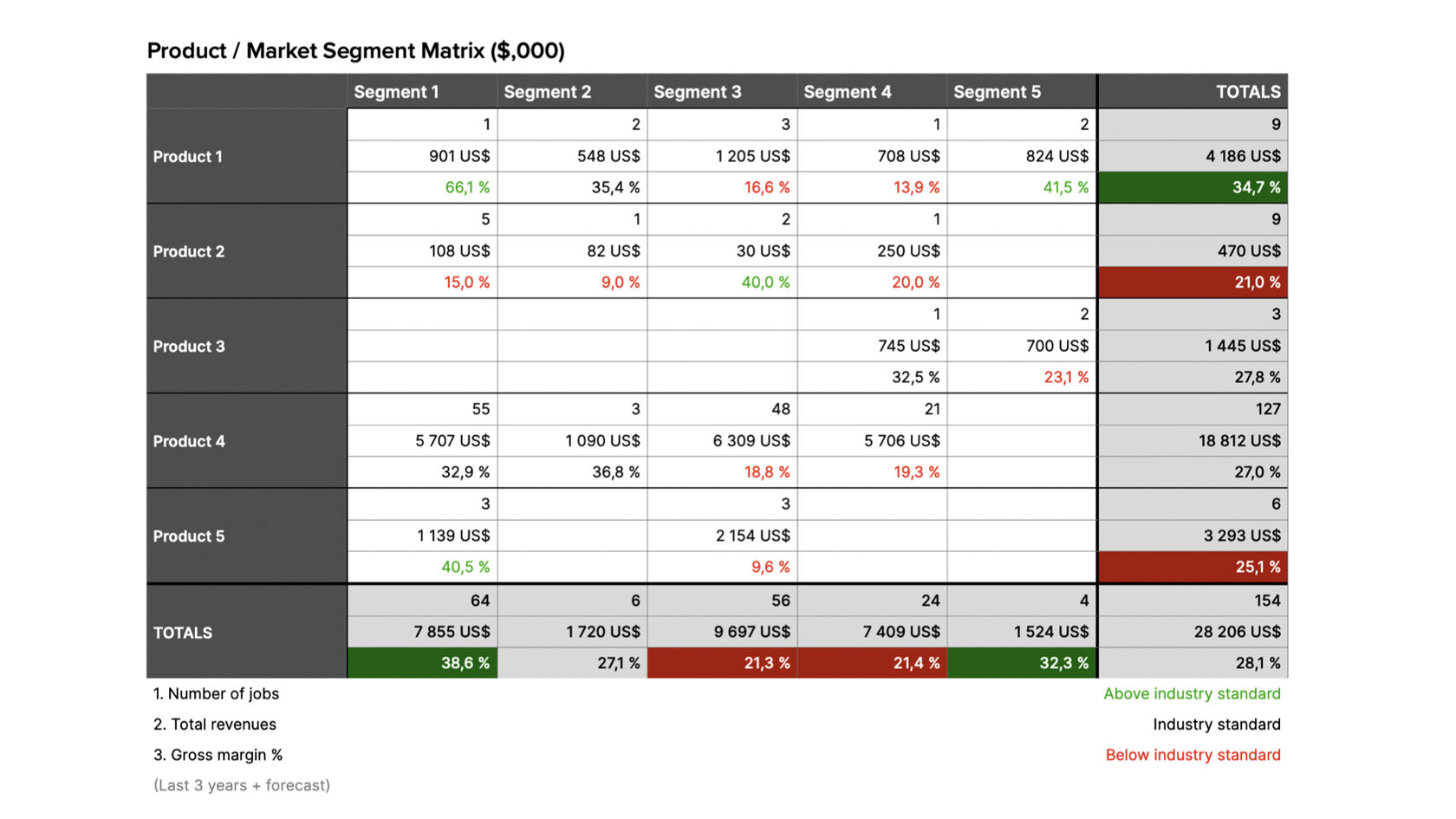
A product/market matrix shows how a business performs against industry standards and helps determine whether you should focus on doing what you do well even better, or correct what you do poorly.
Your chief financial person should be able to complete this matrix (see figure 3) in a couple of hours.
Figure 3: Product/market matrix
Focus on user needs
Yet users know what they want — these are deeper, more enduring desires that change less frequently. To work out what users really need, focus first on what they want.
A lucky business is one that can ask users directly what they want. But most businesses can’t do this. They have to use proxies: speaking to those who interact with users, such as sales and support teams.
Ask users directly, or their proxies, these simple questions and record their answers:
- How do you see yourselves?
- How do you feel about the world around you?
- What do you want?
Purpose-Users-Needs (PUN) Template
When you know your users and have an idea of what users want, capture this in a PUN template (see figure 4) along with the crucial information previously gathered at the Grand Strategy stage (see part 1):
- Who are you (Q1), what do you do (Q2) and why do you do this (the owner’s end-goal) (Q3).
- The missions the business must complete (Q4) to deliver the end-goal sought.
- The users the business will focus on (Q5) and your understanding of what these users want (Q6).
Figure 4: PUN Template (Purpose, Users, Needs)
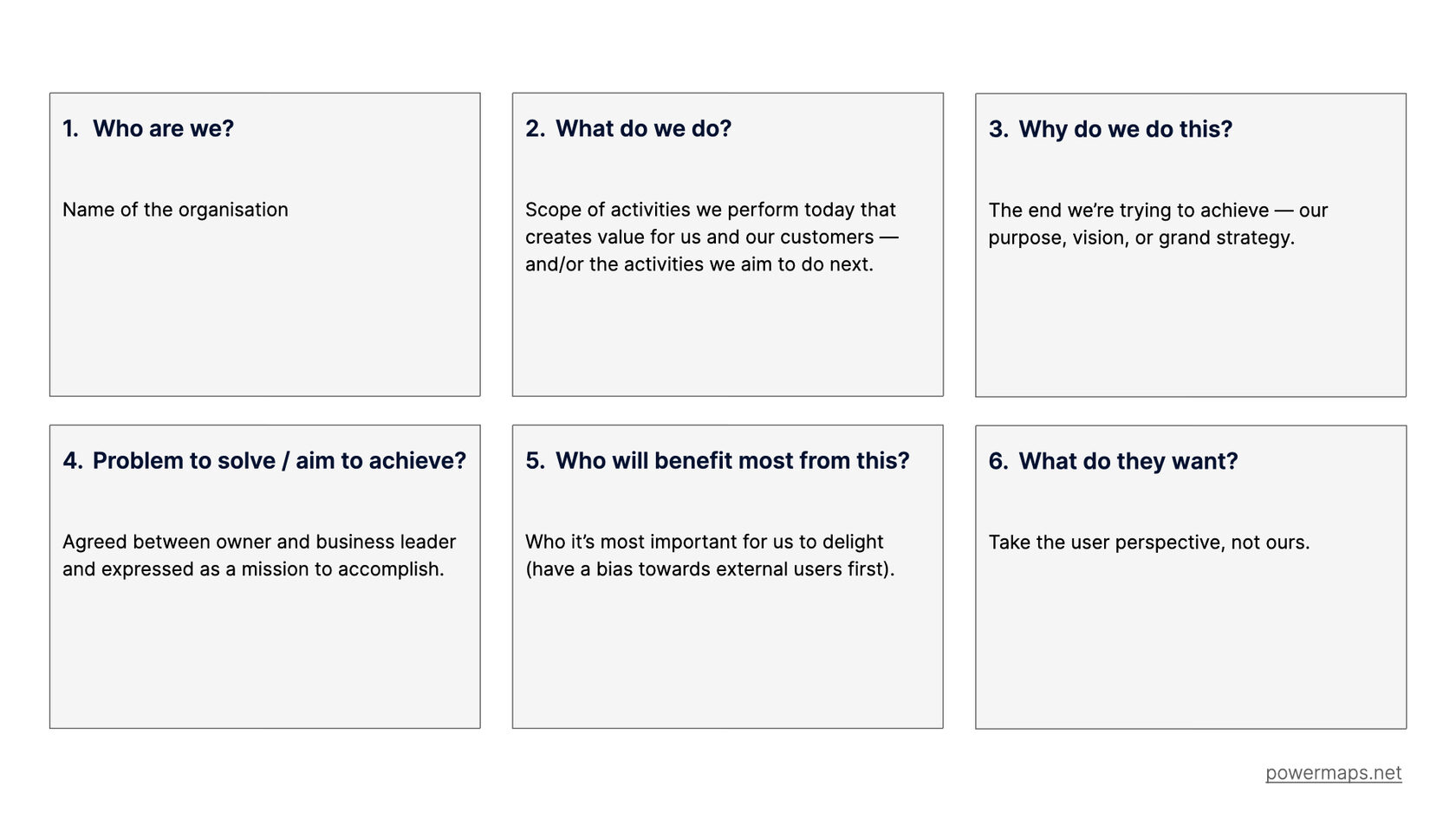
Complete a separate PUN for each mission and for each user who matters most. Share this completed template across your business to create widespread focus (on users) and alignment (around their needs).
Position
Now you know your users and what they want, your attention should turn to the components (activities, practices, knowledge, and data) you need to deploy to satisfy their desires and create value.
Take the user perspective (not your own!) and ask:
- What do users think they need (in order to get what they want)?
- What solutions are they looking for to satisfy those needs?
- Which components are needed to provide those solutions?
This is how we start to create a Wardley Map — an approach used by thousands of leading organisations globally to develop situational awareness.
Worked Example:
My users are business leaders who want to win. To do this, they need to make better choices. The solution that delivers that is a strategy. Figure 5 shows the Value Chain of components a strategy needs.
Figure 5: Value Chain
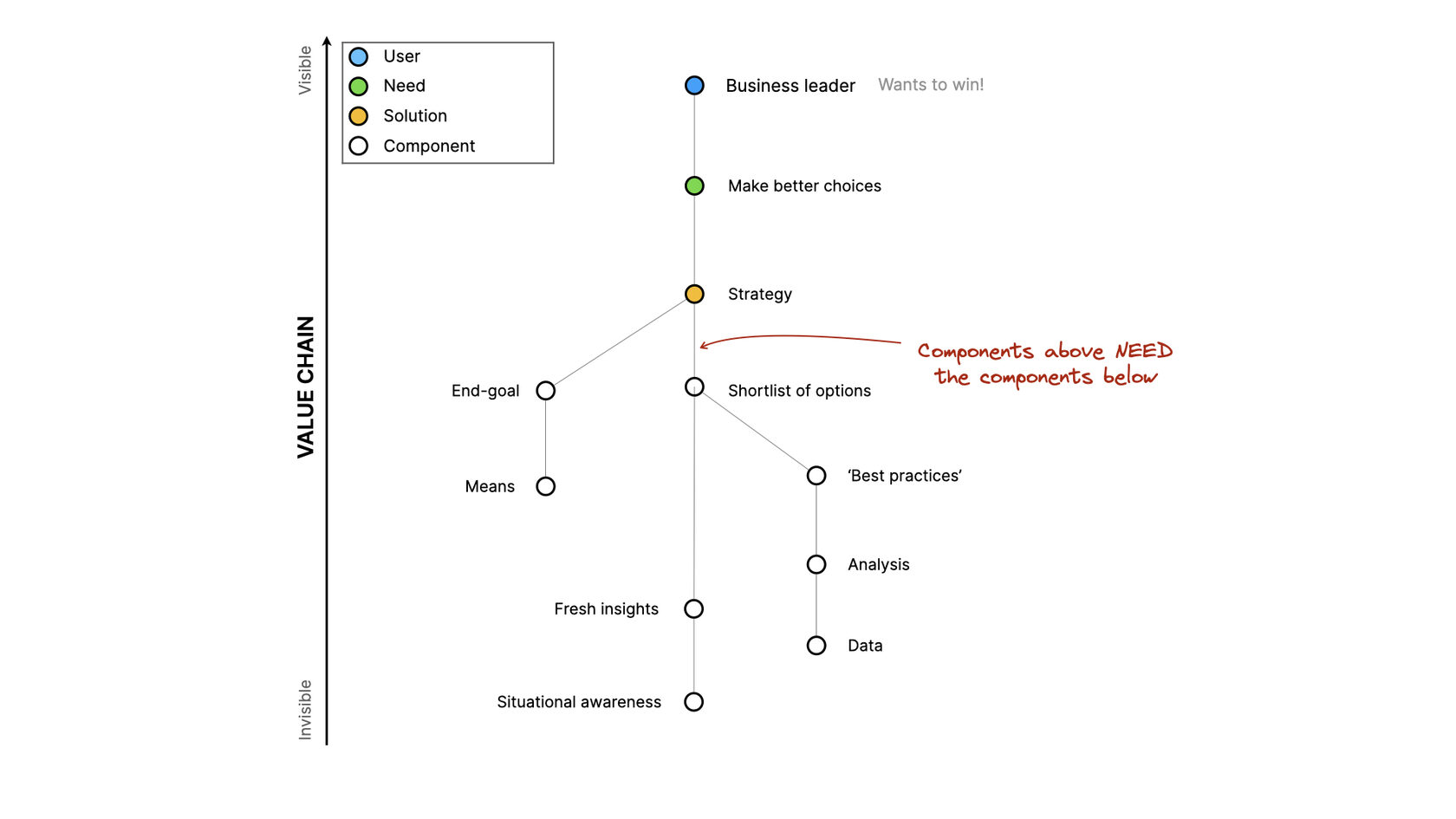
Each component in the Value Chain needs the one below it. This gives all components a position — the higher up the Value Chain, the more visible this component is to users and the more users value it.
In this example, a shortlist of options is higher up the Value Chain and more visible to users than the data or analysis needed to compile it. This has major implications for strategy, which we’ll explore in part 3.
Movement
Business landscapes are not static. Everything we do and how we do it is changing, driven by supply and demand competition. To succeed, we must skate to where the puck is going.
Every component in a Value Chain is moving from left to right, from:
- The Uncharted space (on the left) where components are new to the world, or new to our market (genesis or custom-built components)
- Through a Transitional space (in the middle) where businesses compete by improving components (product or rental components)
- To the Industrialised space (on the right) where components become more of a cost of doing business (commodity or utility components)
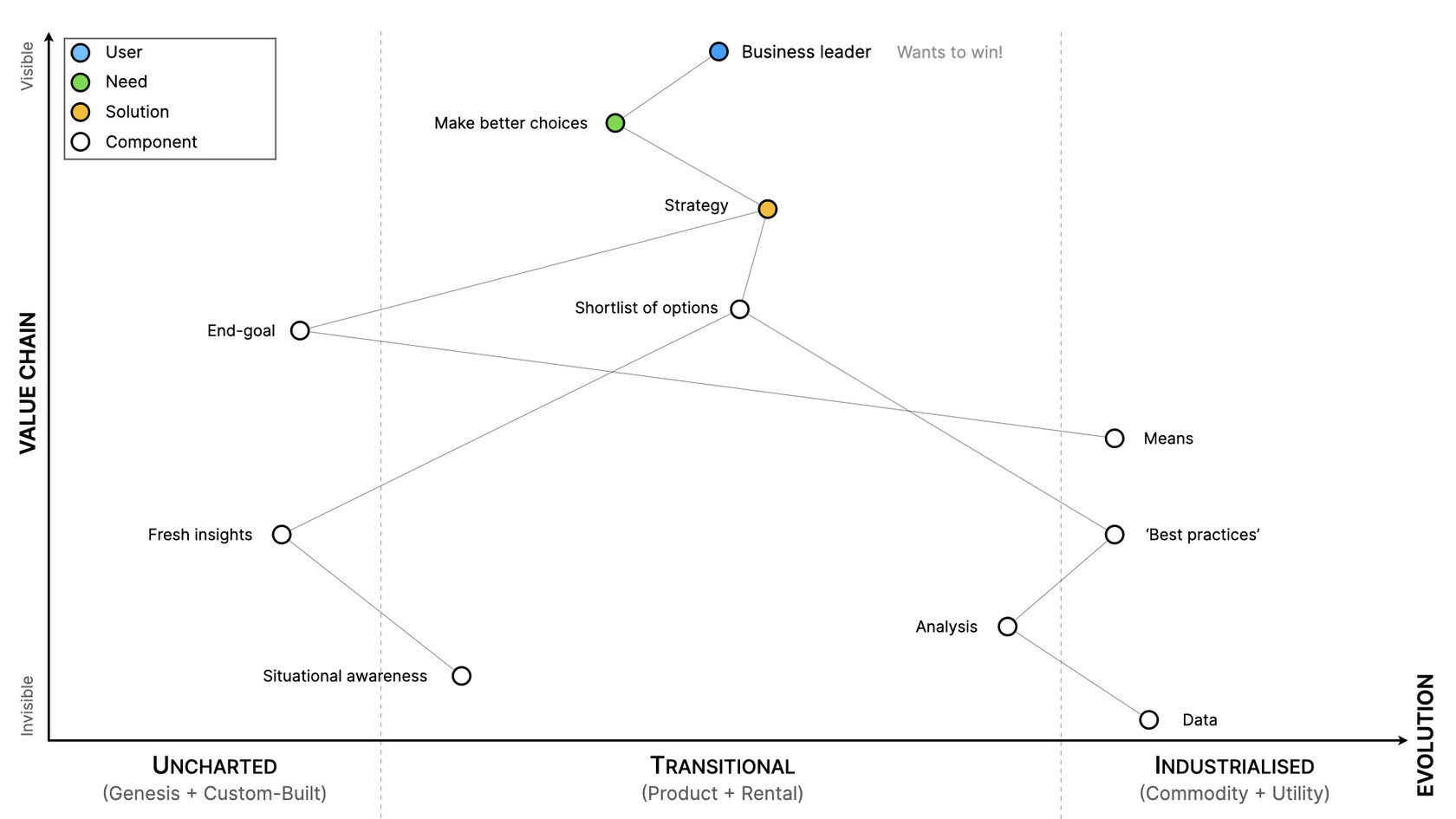
Placing components from my Value Chain into their appropriate space on a Wardley Map shows how evolved these components are — or, how widespread certainty is about them today in my market (see figure 6).
Figure 6: A Wardley Map2
Worked Example:
My users need to make better choices than their rivals. This is widely understood in my market, but there’s some uncertainty about how to do it, so I’ve placed this component slightly towards the left on the map.
The importance of determining an end-goal for the business is even less widely understood, so I’ve placed this further to the left. But means analysis is widely understood, so I’ve placed this far to the right.
Making better choices requires a strategy, which needs a good shortlist of options to choose from. These have a good deal of certainty about them in my market, so I’m placing them in the middle as standard products.
In my market, strategy means copying ‘best practices’, so I’ve placed that component — and the analysis and data needed to do it — far to the right, as these are commodity-like activities or practices.
An alternative to ‘best practices’ is to find fresh insights into new, potential sources of value others haven’t seen. This requires situational awareness. I’m placing both to the left as they’re not widely understood (yet).
This gives me a Wardley Map of my business landscape, showing me who my target users are, what they want, what they think they need, the solutions they might be looking for and how my market satisfies this.
I can see that, in my market, best practices, means and analysis are commoditised (on the right) — meaning rivals compete on price. While fresh insights is in the uncharted space (on the left) and largely untapped.
Now I have a clear visualisation of what my users care about (components top of the map) and where new sources of value may be (on the left). This will help me determine better strategic moves (see part 3).
Takeaway
Wardley mapping shows a business landscape from the perspective of users. Position shows what users value most. Movement shows how evolved each component is, and where new sources of value may be.
Situational awareness is understanding how value is created today and where conditions are changing next. Now we can explore how to shape those conditions to our advantage.
1 Seeing What Others Don’t: The Remarkable Ways We Gain Insights. Gary Klein (2013)
2 This map is a simplified version of the 4 stage Wardley Map. The 3 stage PowerMap variation combines the Genesis and Custom-built stages into the Uncharted stage, and renames the other two stages (from Product to Transitional and from Commodity to Industrialised).