A business needs a grand strategy — a clear expression of the owner’s intent for it. Without this, the business leader might take the organisation in the wrong direction. Therefore, the owner must clearly communicate to the business leader the destination they should be aiming for.
This requires an honest conversation between owner and leader around three deceptively simple questions:
This creates alignment at the highest level. Now the business leader can break the grand strategy down into intermediate aims to achieve and immediate problems to solve. These become the missions for the business — which must be consequential, in enabling the business to reach its destination, but also achievable.
If the owner was Elon Musk — whose grand strategy is multi-planetry civilisation — our missions might be:
Intermediate aim: Thriving human colony on Mars.
Problems to solve: Building rockets to get humans to Mars | Creating infrastructure for humans to survive on Mars | Inventing sustainable supply chains so humans can thrive on Mars independently.
Identifying missions is not easy, but it needs to be done — otherwise, talent focuses on the wrong things. Leaders must also refrain from jumping to solutions before deciding which missions to focus on, as this leads to overreach — with the leader trying to decide everything themselves — which weakens the business.
The PUN Template (Purpose, Users, Needs)
Businesses don’t survive by satisfying the owner’s needs alone. It also has to delight others — talent, suppliers, wider society and, most importantly, paying customers. Therefore, we have to take the user perspective next — identifying what they want and what the business needs to satisfy.
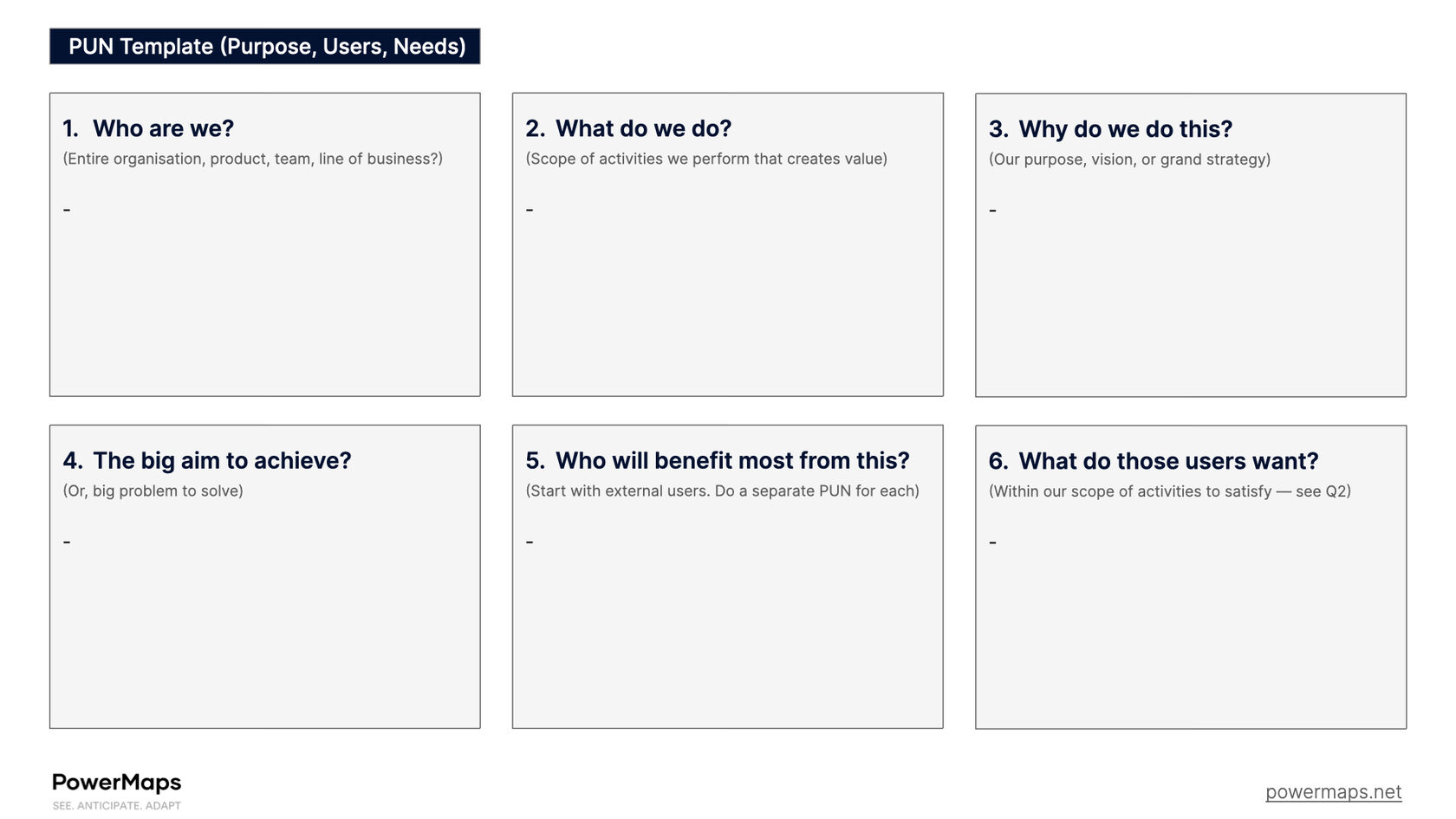
This requires answering the next three questions on the PUN template (see picture attached):
Now we have a grand strategy; a series of missions critical to achieving it; an understanding of who will pay for this (paying users); and a view on what those users really want. We can now share our PUNs widely in the organisation to get everyone on the same page — creating alignment between owner, leader, and talent.
The business is now ready to take action.
Quick Test
List the top three missions you’re working on.
For each one ask: If this were solved, would it materially move us towards our destination?
If not, your missions may be not be consequential and talent and resources are being wasted in activity that the owner won’t value, even if you get there.
What Next?
The art of situational awareness — the most important skill in business today.
To follow this series join the Telegram channel t.me/wardleymapping
Or subscribe to the blog https://powermaps.net/blog
If you found this post useful consider sharing it with others.
And if you’d like to think and act strategically in your organisation explore more here: https://powermaps.net
This requires an honest conversation between owner and leader around three deceptively simple questions:
- Who are we? (The business)
- What do we do? (The activities we perform that create value)
- Why do we do this? (Our purpose).
This creates alignment at the highest level. Now the business leader can break the grand strategy down into intermediate aims to achieve and immediate problems to solve. These become the missions for the business — which must be consequential, in enabling the business to reach its destination, but also achievable.
If the owner was Elon Musk — whose grand strategy is multi-planetry civilisation — our missions might be:
Intermediate aim: Thriving human colony on Mars.
Problems to solve: Building rockets to get humans to Mars | Creating infrastructure for humans to survive on Mars | Inventing sustainable supply chains so humans can thrive on Mars independently.
Identifying missions is not easy, but it needs to be done — otherwise, talent focuses on the wrong things. Leaders must also refrain from jumping to solutions before deciding which missions to focus on, as this leads to overreach — with the leader trying to decide everything themselves — which weakens the business.
The PUN Template (Purpose, Users, Needs)
Businesses don’t survive by satisfying the owner’s needs alone. It also has to delight others — talent, suppliers, wider society and, most importantly, paying customers. Therefore, we have to take the user perspective next — identifying what they want and what the business needs to satisfy.
This requires answering the next three questions on the PUN template (see picture attached):
- The big aim to achieve? (Or problem we’re trying to solve — i.e. one of the missions)
- Who will benefit most from this? (NB:— prioritise paying users first)
- What do those users want? (Take their perspective — what are they looking for?)
Now we have a grand strategy; a series of missions critical to achieving it; an understanding of who will pay for this (paying users); and a view on what those users really want. We can now share our PUNs widely in the organisation to get everyone on the same page — creating alignment between owner, leader, and talent.
The business is now ready to take action.
Quick Test
List the top three missions you’re working on.
For each one ask: If this were solved, would it materially move us towards our destination?
If not, your missions may be not be consequential and talent and resources are being wasted in activity that the owner won’t value, even if you get there.
What Next?
The art of situational awareness — the most important skill in business today.
To follow this series join the Telegram channel t.me/wardleymapping
Or subscribe to the blog https://powermaps.net/blog
If you found this post useful consider sharing it with others.
And if you’d like to think and act strategically in your organisation explore more here: https://powermaps.net