Obey the principles without being bound by them
— Bruce Lee
Every operational objective we aim to achieve will encounter unforeseen problems due to the complexity and uncertainty of reality. The tactical level is about overcoming such problems and requires team effort. To solve complex problems teams need diverse knowledge, skills and experience and this creates a secondary problem: how do such diverse people work together effectively?
Tactics require:
- Principles: guides to action, regardless of context.
- Phased adoption: build solid foundations first.
- Measurement: is action effective, efficient and enduring?
Principles
Teams that work directly with external users, such as customers, suppliers or regulators, must solve a range of problems that nobody could have predicted. The decisions they make can be tactically sound (e.g. offering a discount to land a new client) but strategically counterproductive (e.g. signalling that existing clients overpay). The tactical level, where the business interacts with users, is too important to run anarchically.
Running tactical decisions through senior leaders is impractical. Leaders become overloaded and form a bottleneck, preventing teams from making the fast responses needed to delight users. Creating rigid rules to govern the action of frontline teams slows action down. It also alienates frontline talent who are not trusted to think for themselves. They leave, placing a burden on those who stay behind.
Involving frontline teams in the strategic thinking process — from mapping for situational awareness to the sequencing and coordination of operational plans — creates thinkers who are also doers. Talent is able to recognise problems, devise solutions and put them into action. But they can still get overwhelmed by the noise of day-to-day interactions. Teams need support.
Principles guide, explain and educate those who take action. These ‘common ways of doing things’ are approved by the business so carry authority. Principles help structure the behaviour of teams, but remain loose enough to allow talent to exercise judgement in how to apply them. Principles provide guidance, not rules. And, if talent finds better ways of operating, you can adopt these as new principles to guide future teams.
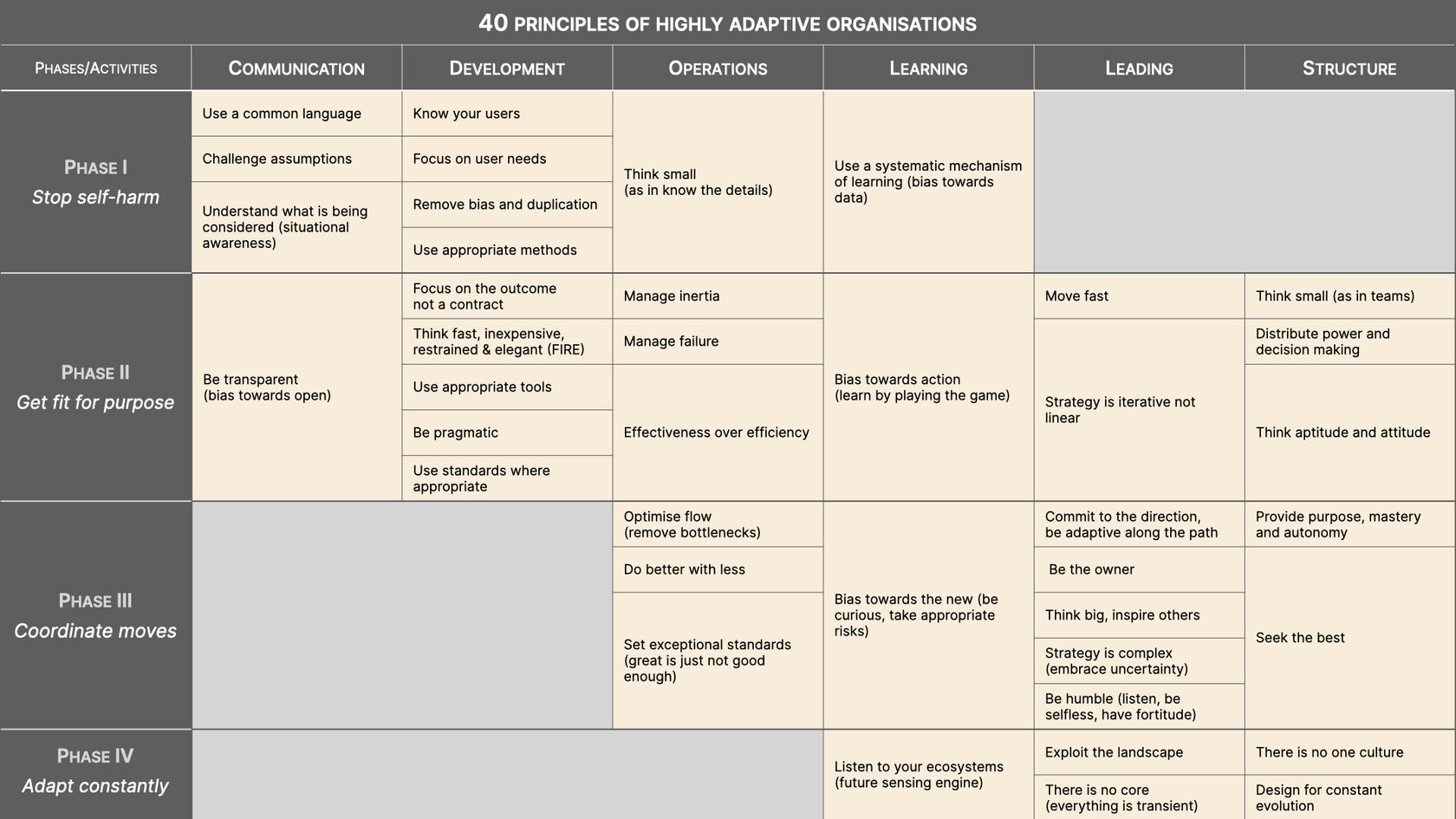
Wardley Mapping contains 40 principles to get you started, drawn from research into some of the most successful organisations worldwide. These are the way their teams communicate, develop, operate and learn and how their leaders lead and structure their organisations to navigate turbulent and unpredictable conditions. These principles may look like common sense, but sense is less common than it should be.
Figure 15: Wardley’s common operating principles
Phased Adoption
The 40 principles are grouped into four phases, each building on the foundation laid in the previous phase. Start with phase 1 principles to ’stop self-harm’ by learning to communicate effectively, knowing your operations in detail and having a systematic way of learning will put you ahead of many of your rivals.
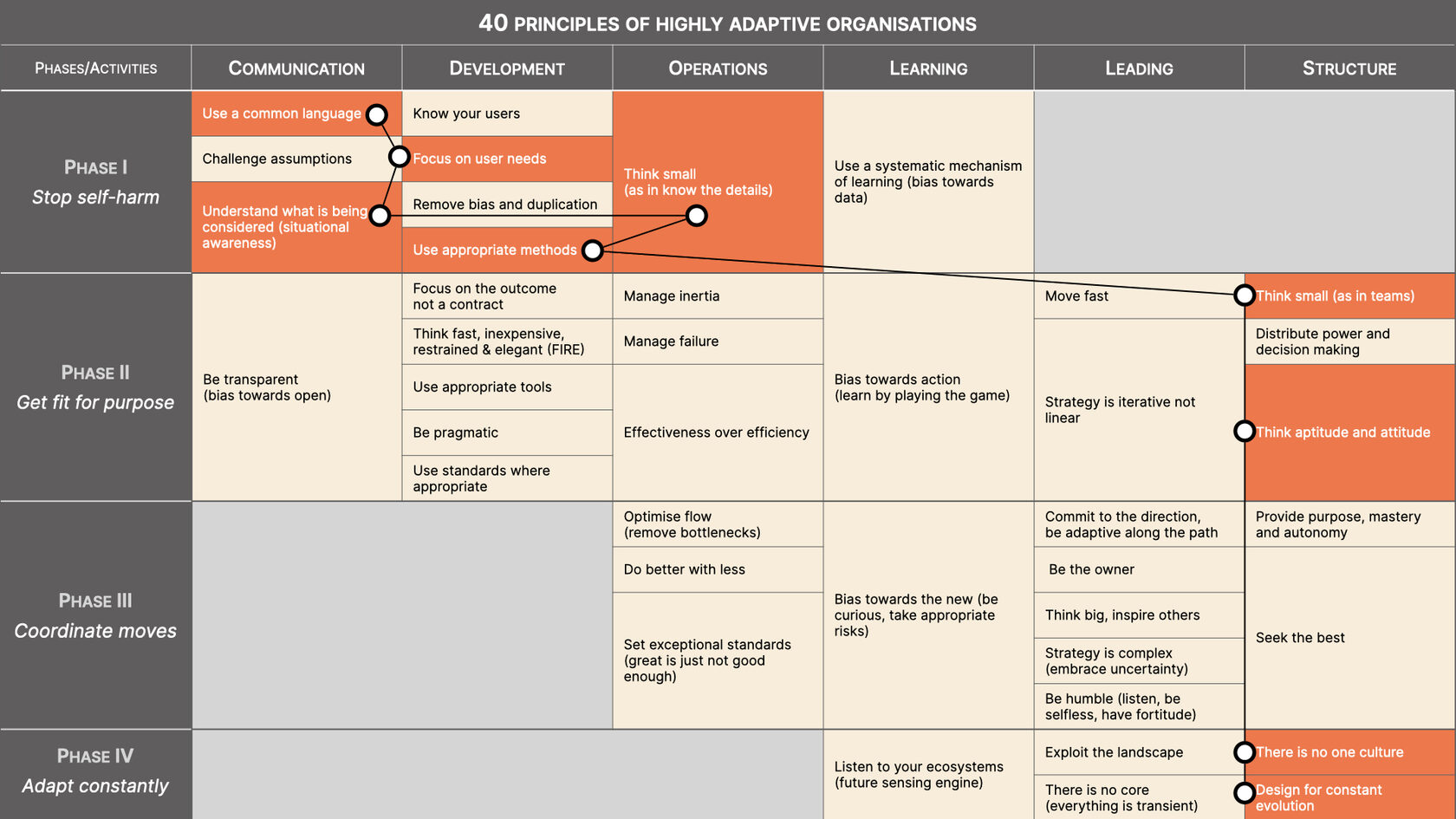
Here are nine principles for transforming from a siloed structure to one that constantly evolves (figure 16):
(1) Use a common language so teams across the entire business can communicate with each other effectively. Maps are that common language, but they require us to (2) focus on user needs rather than on a team’s needs. Once we have a common language (maps) and focus (satisfying users’ needs) everyone in the business can (3) understand what is being considered (situational awareness) and their roles in realising it.
Now we can start to (4) think small (as in know the details) to satisfy those user needs and see how we create value today. Rather than a ‘one size fits all’ approach’ to make managing operations easier, we let teams (5) use appropriate methods as inventing the new requires different approaches from commercialising or scaling it. We can also (6) think small (as in teams), with each focused on its part of the map.
Teams need a variety of skills (e.g. marketing, IT and finance) but also attitudes. Some teams will need those who can discover new sources of value in uncertain conditions and other teams will need those who are adept at scaling the known. We need to (7) think aptitude and attitude and recognise (8) there is no one culture: businesses need people with the right skills and attitudes to manage components across evolving landscapes.
This is how a business (9) designs for constant evolution: Connectors, commercially minded teams, ‘steal’ the breakthroughs of innovators and turn them into products. Adaptors turn maturing products into reliable platforms so innovators can build new sources of value on top of them. This ability to adapt constantly removes the need for large-scale transformations every few years in response to market changes.
Figure 16: Nine principles for transforming a siloed organisation into one that constantly evolves
Measurement
The tactical level is the place ambitions, insights, ideas and plans are transformed into action. Leaders often feel overwhelmed by the sheer scale and complexity of it. Many set Key Performance Indicators (KPIs) to provide a comforting sense of certainty about what should happen. But KPIs often measure conformity (did you do what you were told) rather than performance (was this the right thing to do).
Plans don’t survive contact with reality because they can lock us into paths that have become sub-optimal. But if promotions and bonuses are tied to KPIs then staff will keep focusing on hitting them rather than responding to a changing environment. We need different ways to measure the performance of our talent:
- Effective: did their action achieve the operational objective set?
- Efficient: did they do so with the resources originally intended?
- Enduring: did this lead to a lasting advantage?
Teams must focus on achieving operational objectives, discussing with leaders in real-time if more (or less) resources are required. Leaders must bet on action they think has the greatest chance of enduring success. Sometimes this will mean being effective (doing the right thing), other times being more efficient (doing things right). The tactical level is filled with uncertainty and requires flexibility in action.
Worked example
My map (figure 17) shows our operational objectives and the sequencing needed to make a ‘land grab’ move: enabling businesses, starting with small and medium sized enterprises (SMEs), to do ‘discovery’ themselves, which will undermine our rivals’ business models. This map shows the right methods to use, the right ways of investing, and the right types of people to deploy.
Figure 17: Apply principles to my map
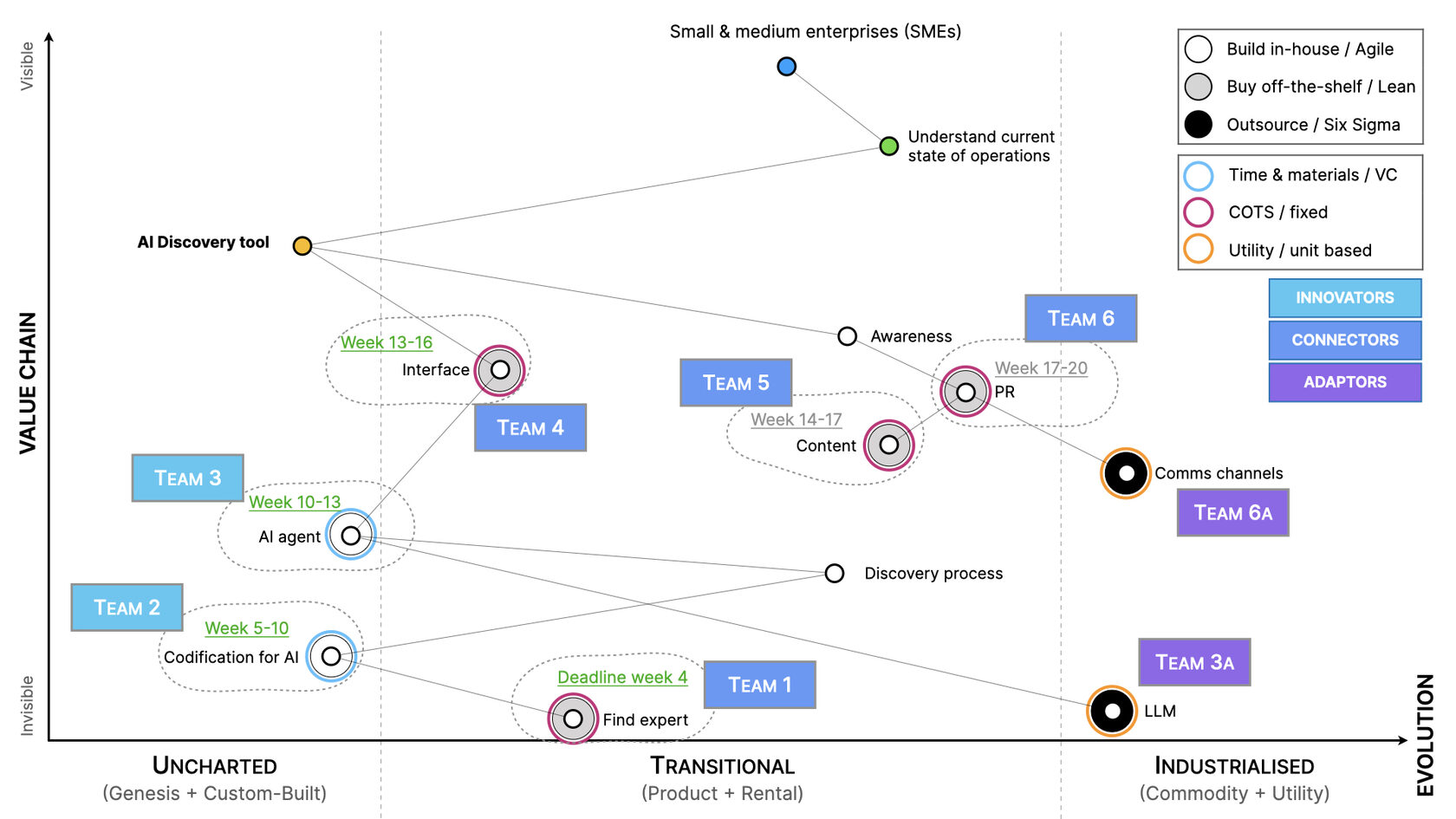
Components on the left, in the uncharted space, carry high levels of uncertainty in my market. There are few suppliers who can provide something effective here, so we’ll have to build these in-house with Agile methods or partner with others innovators who are comfortable with uncertainty. We’ll invest in time and materials or take a venture capital approach to give us freedom to scale up or down.
Components in the middle, in the transitional space, carry more certainty. We can buy these components off the shelf from suppliers or manage them ourselves with methods like Lean, learning as we go and removing waste to improve margins. For this we need connectors: teams in touch with the market, who understand what users want and what suppliers offer.
Components on the right, in the industrialised space, carry widespread certainty. We’re not going to reinvent the wheel here. We’ll use platforms that already exist and pay for what we use so our teams can do their job. We’ll deploy a team of adaptors here to manage these services, securing us the best value deals and ensuring we use them in the most efficient ways.
Teams know what to do and how to do it. They also know what to expect of other teams, especially those teams further down the Value Chain on whom everyone else relies (and those teams can see who their users are). We’ll give these teams the freedom to decide how best to work together and meet the operational objectives set, only stepping in if interactions between them break down or in an emergency situation.
Takeaway
The tactical level is where action takes place. Frontline teams need the freedom to make decisions in response to situations we can’t predict in advance.
Principles guide teams towards consistent, coherent action with others, while leaving room for their judgement. Measure action by whether it is effective, efficient and enduring.