Business is a democratic game because others — customers, rivals, suppliers, society — also have a say. They make moves independently of us, forcing us to adapt. This is why plans never survive first contact with reality. We are continually forced to adapt to reality — requiring better decision-making throughout the organisation.
Stable v Dynamic
Some leaders choose to see the world the way they wished it was: stable, with lots of certainty, where what worked yesterday somewhere else will work here today. In this stable world view, the tactical level is merely the execution of a strategic plan, controllable and measurable with KPIs.
Other leaders recognise the world the way it is: dynamic and uncertain, where understanding the flow of events and adapting is essential. In this dynamic world view, the tactical level is where strategy is tested — with observations about what’s working and what’s not fed back into the strategic thinking process.
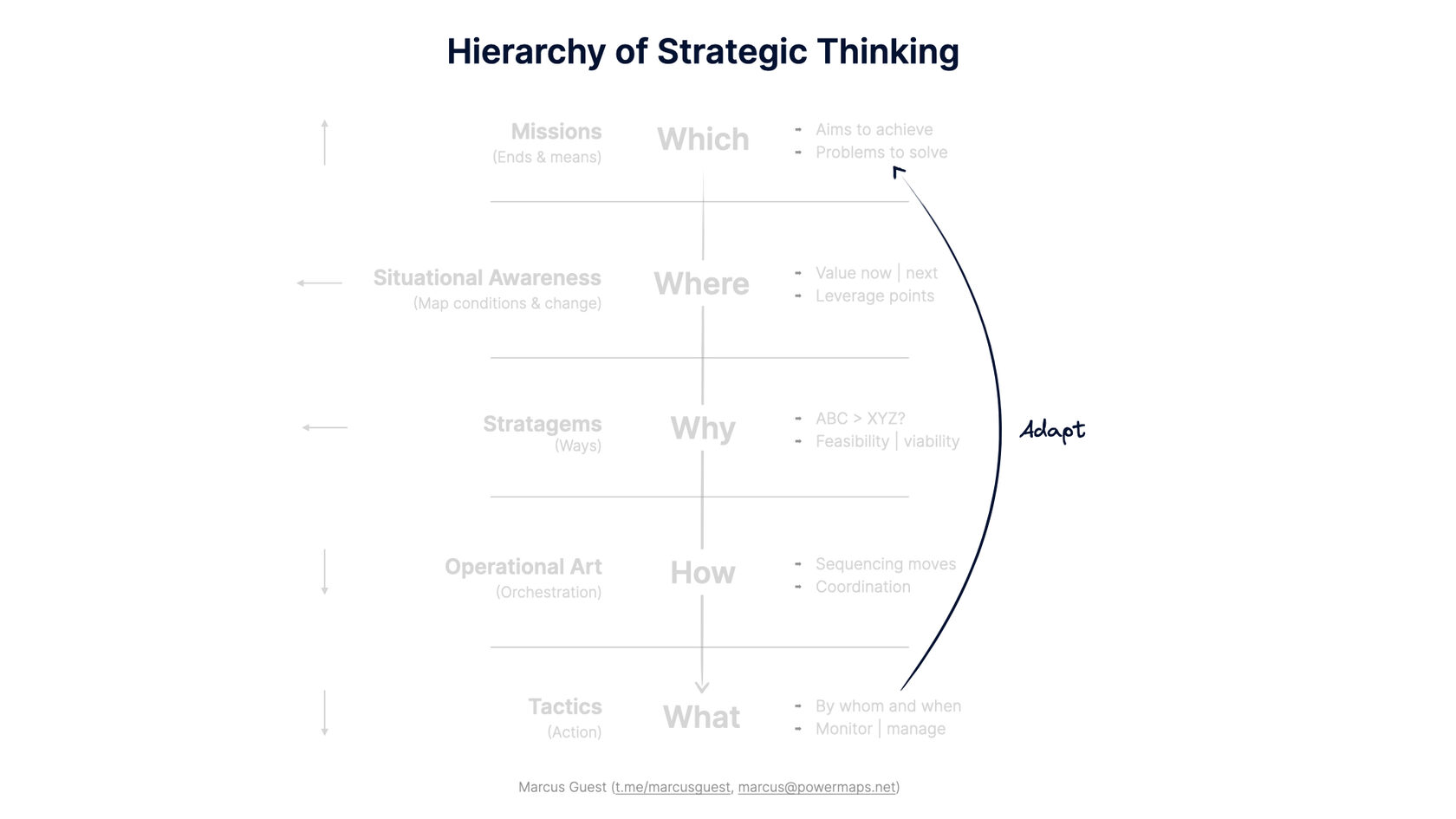
Strategic thinking informs the daily choices we make when interacting with others. But these interactions also provide rich information that enables us to discover better ways of thinking and acting — closing the gap between our hypotheses and reality. Strategy guides tactical action — but tactics inform strategic thinking.
Fixed v Flow
A constant flow of rich information from the tactical level fuels the strategic thinking process — enabling us to respond better to user needs, rival moves, or market changes. Organisations adept at feeding tactical information back into their strategic thinking process learn quicker what’s working, what isn’t and why.
Tactical level information — flowing from the frontline back into the strategic thinking process — informs us whether we need to concentrate our aims, widen them, or change them completely. Weak strategists ignore these signals when they contradict their overly-detailed, expensively constructed strategic plans.
But strong strategists — those able to move through the Hierarchy of Strategic Thinking effortlessly — embrace new insights. Using them to adjust their priorities, they refocus their aims or refine the action they’re taking — doing more of what works, and less of what doesn’t.
Strategy starts with agreement on what we’re trying to achieve (missions), understanding where to focus (awareness), deciding why these moves over those (stratagems) and how to make them (operational art). Then we act — crossing the wild and unpredictable river one stepping stone at a time — adapting as we go.
Quick Test
Think about the last time frontline talent learned something new from users or rivals. What happened next?
If the latter, your organisation is failing to learn as it goes. External changes will disrupt you sooner or later.
What Next?
The concluding part: developing leadership awareness.
To follow this series join the Telegram channel t.me/wardleymapping
Or subscribe to the blog https://powermaps.net/blog
If you found this post useful consider sharing it with others.
And if you’d like to think and act strategically in your organisation explore more here: https://powermaps.net
Stable v Dynamic
Some leaders choose to see the world the way they wished it was: stable, with lots of certainty, where what worked yesterday somewhere else will work here today. In this stable world view, the tactical level is merely the execution of a strategic plan, controllable and measurable with KPIs.
Other leaders recognise the world the way it is: dynamic and uncertain, where understanding the flow of events and adapting is essential. In this dynamic world view, the tactical level is where strategy is tested — with observations about what’s working and what’s not fed back into the strategic thinking process.
Strategic thinking informs the daily choices we make when interacting with others. But these interactions also provide rich information that enables us to discover better ways of thinking and acting — closing the gap between our hypotheses and reality. Strategy guides tactical action — but tactics inform strategic thinking.
Fixed v Flow
A constant flow of rich information from the tactical level fuels the strategic thinking process — enabling us to respond better to user needs, rival moves, or market changes. Organisations adept at feeding tactical information back into their strategic thinking process learn quicker what’s working, what isn’t and why.
Tactical level information — flowing from the frontline back into the strategic thinking process — informs us whether we need to concentrate our aims, widen them, or change them completely. Weak strategists ignore these signals when they contradict their overly-detailed, expensively constructed strategic plans.
But strong strategists — those able to move through the Hierarchy of Strategic Thinking effortlessly — embrace new insights. Using them to adjust their priorities, they refocus their aims or refine the action they’re taking — doing more of what works, and less of what doesn’t.
Strategy starts with agreement on what we’re trying to achieve (missions), understanding where to focus (awareness), deciding why these moves over those (stratagems) and how to make them (operational art). Then we act — crossing the wild and unpredictable river one stepping stone at a time — adapting as we go.
Quick Test
Think about the last time frontline talent learned something new from users or rivals. What happened next?
- Did the organisation adjust quickly?
- Or did it kick it down the road to the next strategy and budget planning cycle?
If the latter, your organisation is failing to learn as it goes. External changes will disrupt you sooner or later.
What Next?
The concluding part: developing leadership awareness.
To follow this series join the Telegram channel t.me/wardleymapping
Or subscribe to the blog https://powermaps.net/blog
If you found this post useful consider sharing it with others.
And if you’d like to think and act strategically in your organisation explore more here: https://powermaps.net