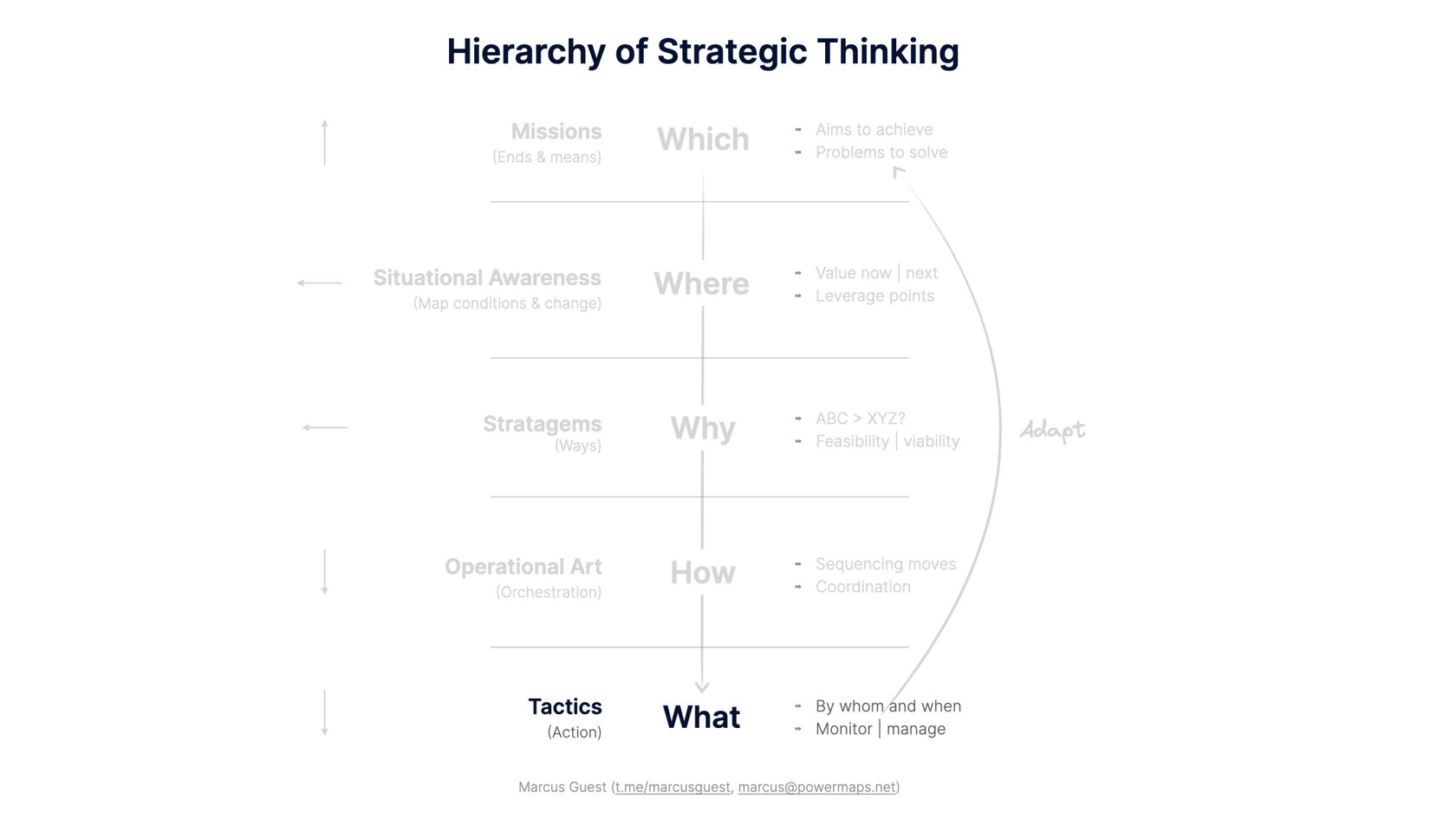
The tactical level is the point of contact with users — customers, suppliers and society. Here is where a multitude of choices need to be made every day to solve user problems and drive progress. And when talent understands what the organisation is trying to achieve and how, they consistently make better choices, faster.
Tactics are not execution — they’re strategy in action.
Being Tactical
Tactical choices are made within the boundaries set by strategy. They should follow a path of least resistance, with each choice moving us in the right direction and building momentum. Theses benefits — short-term, compounding wins — are, however, the reason some leaders favour being tactical over being strategic.
Privileging tactics over strategy has clear speed and cost advantages as resources are not “wasted on yet another plan” that fails to survive contact with reality. While experienced leaders who consistently make good decisions can create a coherent line of action that talent can understand and follow.
Yet, short-term tactical benefits often lead to long-term strategic disadvantages. Without a strategy that explains why a leader is making such decisions talent never learns how to make good choices themselves and end up defaulting to the leader for every choice that needs to be made.
Such organisations become constrained by the leader’s cognitive capacity: how many decisions can they make in a day? How much talent can they interact with? How much time do they have to learn what’s changing in the wider landscape and how this might impact the organisation?
The Tyranny of Tactics
Tactical leaders — those making all the key choices themselves — repel high-quality talent. Replaced by more compliant talent — those content to let choices be made for them — starves the organisation of the requisite variety of perspectives needed to adapt effectively to a world changing rapidly around them.
Trapped in an ever-tightening loop of short-term decisions, tactical leaders jump from fighting one fire to the next, repeating themselves in every interaction, thinking out loud, hoping a consistent narrative orchestrates more coherent lines of action. Concerns about the outside world fall out of scope.
When external shocks inevitably hit — events, rivals, technologies — talent turns to the leader for direction. But already drained the leader struggles to respond. The focus on quick, cost-effective tactical wins — driven by one person — made the entire organisation fragile and now threatens its existence.
The leader has burnt out. But if they go now, they’ll leave behind an organisation that’s learned helplessness — lacking clarity about the overall direction of travel and inexperienced in making good choices independently. Everything had depended on one person — who’s no longer there.
Quick Test
Is the leader in your organisation involved in every decision?
Is progress stalled by the email not answered, the call not taken, or the meeting not scheduled?
If so, you’re a tactical organisation and the benefits are unlikely to be sustained over time.
What Next?
Crossing the river by feeling the stones.
To follow this series join the Telegram channel t.me/wardleymapping
Or subscribe to the blog https://powermaps.net/blog
If you found this post useful consider sharing it with others.
And if you’d like to think and act strategically in your organisation explore more here: https://powermaps.net
Tactics are not execution — they’re strategy in action.
Being Tactical
Tactical choices are made within the boundaries set by strategy. They should follow a path of least resistance, with each choice moving us in the right direction and building momentum. Theses benefits — short-term, compounding wins — are, however, the reason some leaders favour being tactical over being strategic.
Privileging tactics over strategy has clear speed and cost advantages as resources are not “wasted on yet another plan” that fails to survive contact with reality. While experienced leaders who consistently make good decisions can create a coherent line of action that talent can understand and follow.
Yet, short-term tactical benefits often lead to long-term strategic disadvantages. Without a strategy that explains why a leader is making such decisions talent never learns how to make good choices themselves and end up defaulting to the leader for every choice that needs to be made.
Such organisations become constrained by the leader’s cognitive capacity: how many decisions can they make in a day? How much talent can they interact with? How much time do they have to learn what’s changing in the wider landscape and how this might impact the organisation?
The Tyranny of Tactics
Tactical leaders — those making all the key choices themselves — repel high-quality talent. Replaced by more compliant talent — those content to let choices be made for them — starves the organisation of the requisite variety of perspectives needed to adapt effectively to a world changing rapidly around them.
Trapped in an ever-tightening loop of short-term decisions, tactical leaders jump from fighting one fire to the next, repeating themselves in every interaction, thinking out loud, hoping a consistent narrative orchestrates more coherent lines of action. Concerns about the outside world fall out of scope.
When external shocks inevitably hit — events, rivals, technologies — talent turns to the leader for direction. But already drained the leader struggles to respond. The focus on quick, cost-effective tactical wins — driven by one person — made the entire organisation fragile and now threatens its existence.
The leader has burnt out. But if they go now, they’ll leave behind an organisation that’s learned helplessness — lacking clarity about the overall direction of travel and inexperienced in making good choices independently. Everything had depended on one person — who’s no longer there.
Quick Test
Is the leader in your organisation involved in every decision?
Is progress stalled by the email not answered, the call not taken, or the meeting not scheduled?
If so, you’re a tactical organisation and the benefits are unlikely to be sustained over time.
What Next?
Crossing the river by feeling the stones.
To follow this series join the Telegram channel t.me/wardleymapping
Or subscribe to the blog https://powermaps.net/blog
If you found this post useful consider sharing it with others.
And if you’d like to think and act strategically in your organisation explore more here: https://powermaps.net