A certain amount of modesty in evaluating the human capacity for prediction should restrain the writer of a plan from long, detailed proposals that predict everything except the events that will actually occur.— Alexander Svechin, Strategy
Making strategic moves requires operational art — the bridge between strategy and tactics. This focuses on aligning action across the entire business to achieve operational objectives.
Operational art requires the involvement of a capable, cross-functional team — high-potential staff on top of the latest developments in critical fields — who help coordinate and support the action of frontline staff.
The art consists in balancing a leader’s need for control with the creative freedom frontline teams need to resolve the many unpredictable challenges they will encounter along the way.
Operational art consists of:
- Lines of operation — an interconnected set of actions to achieve objectives.
- Sequencing and coordination — the order for achieving objectives so action is aligned.
- Operational plans — providing leaders an organisation-wide picture as to what will be done, how and when.
Lines of Operation
Taking action requires breaking stratagems down into clear operational objectives — what needs to be done, how it will be done, and by when. Connected action, where one team depends on another to achieve its objective, forms a line of operation. Businesses have multiple lines of operation at any one time.
The challenge lies in managing multiple lines of operation simultaneously. Leaders must resist the temptation to create a detailed plan to control these moving parts, as rigid plans don’t survive contact with a turbulent reality. Balance must be found between a leader’s need for control and a team’s need for flexibility.
The coordination team helps achieve this balance by working from the ground up: mapping how teams intend to meet their objectives, so others can see and challenge their assumptions. It’s this process of communication and challenge that triggers new insights into better courses of action.
Assisted by the cross-functional coordination team, the leader then negotiates the means (capital and capabilities) teams need to meet their objectives. By negotiating the lowest feasible cost, the leader maximises their own ability to allocate more resources to where they’re needed most.
Worked Example:
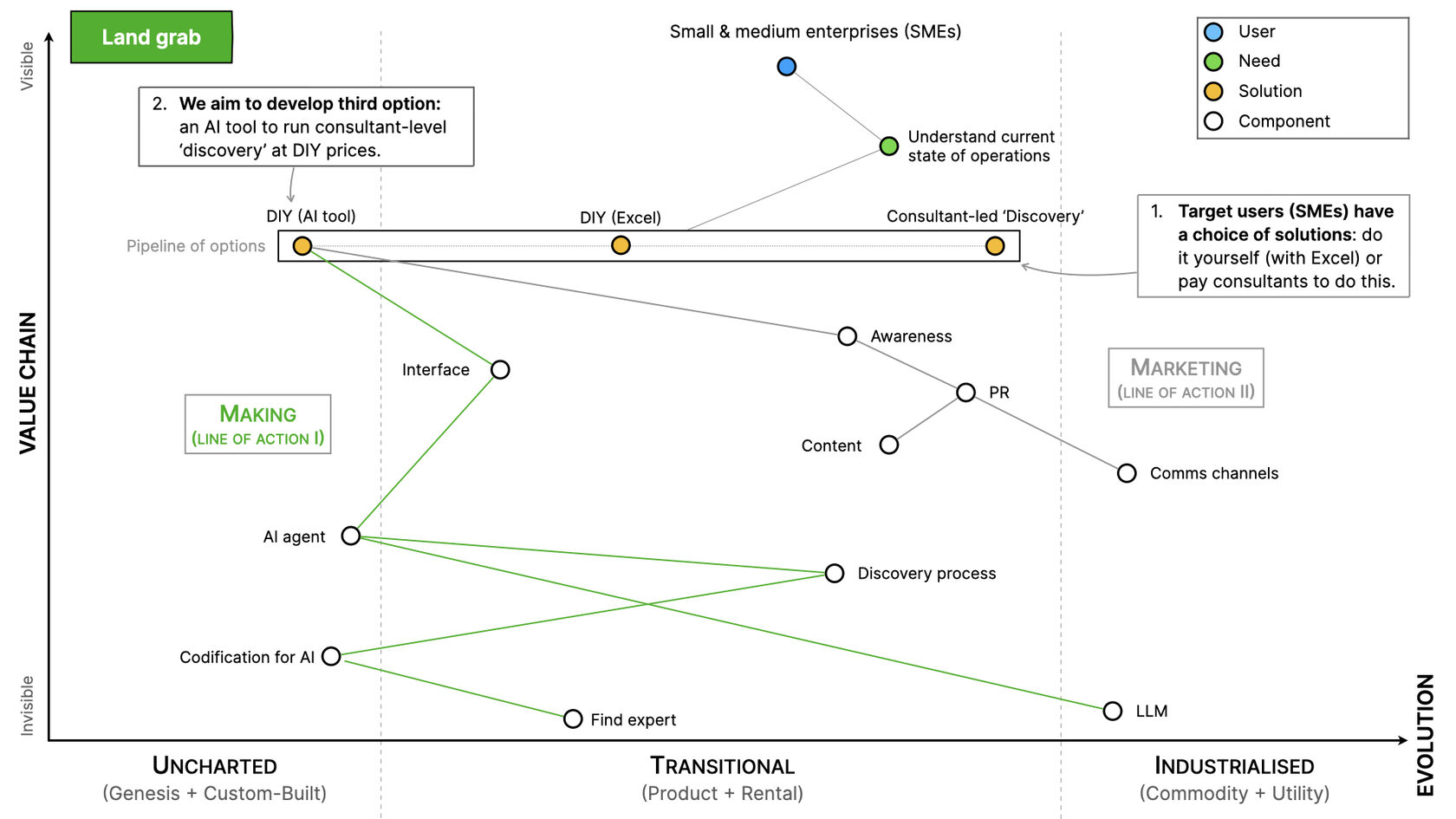
With my partners, we’re mapping how to put stratagem #5 (the land grab) into action. The aim is to create a tool organisations can use to do ‘discovery’ themselves, instead of having to pay external consultants.
The map for this (see figure 12) has two lines of operations: the making and marketing of the new product. We will need to build the tool and find where it fits in our market.
We’re aware that this new product could be seen as a threat to the business model of more powerful rivals, so we’re going to target niche users — small and medium enterprises — to keep us under their radar (for now).
Figure 12: Lines of operation for making and marketing a ‘discovery’ tool.
Sequencing and Coordination
When lines of operation have been mapped and agreed, the sequencing of action can begin. Some action naturally precedes others (e.g. hiring staff to launch a new line of business), while care is needed not to alert powerful rivals to your intentions (e.g. don’t announce the launch of a new business line until it’s ready).
Avoid making long sequences of action to deliver one big success way off into the future. The further into the uncertain future a payoff is, the more unexpected obstacles you’ll have to overcome along the way. Look to create value at every step and encourage teams to pivot if better paths emerge.
Maps help interdependent teams self-coordinate. They can all see the bigger picture they’re a part of, what they can expect from others, and what others expect from them. This visual clarity enables teams to negotiate hand-offs between themselves — agreeing what can be done by when.
Showing teams how they’re interconnected, and how they must work together to achieve shared operational objectives, makes the whole business more than the sum of its individual parts. Leaders only need to step in if self-coordination between teams breaks down, taking control as a last — and temporary — resort.
Worked Example:
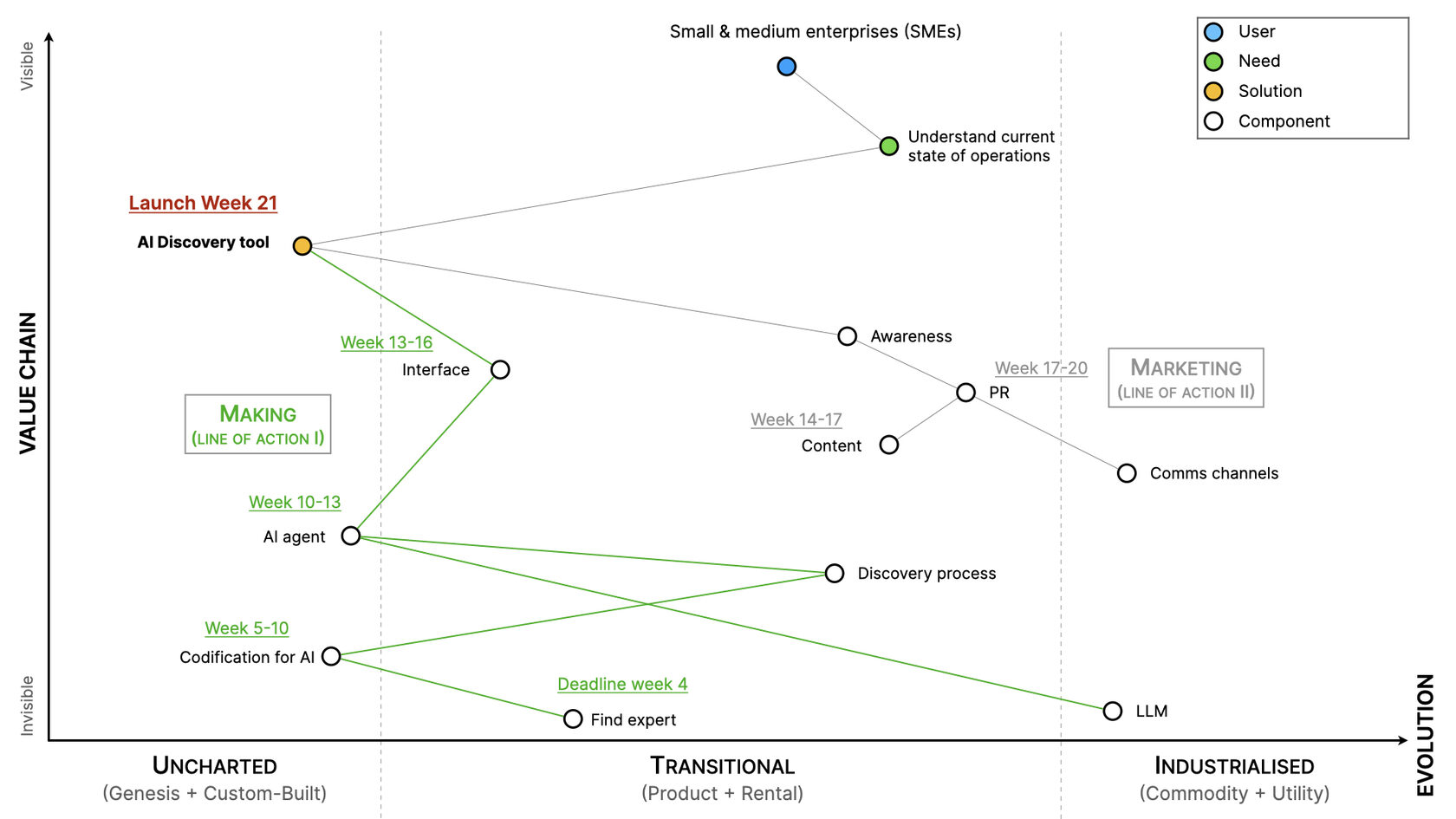
We need to make the product first. This is our priority (see figure 13). Marketing will only start when the product is close to being finished (to stop us alerting rivals too early).
Deadlines have been agreed for delivering each part. These come from negotiations between the coordination team and frontline teams, rather than being imposed on them. Deadlines are expected to be met, but if a deadline starts to slip, that team alerts the teams depending on them, so all can adapt.
Every step creates value. For example, if we make a working ‘AI Discovery tool’, but can’t find a market for it, we can pivot. We can look for partners who have the expertise we lack. This is not a decision we have to make now, but shows how a focus on completing each objective gives us new and better options for action.
Figure 13: Sequencing lines of operation.
Operational Plans
Operational plans are a small but important part of turning thinking into action. Plans should be as simple as possible. Overly detailed plans force teams to be heads down, hitting artificial targets, rather than seeking to do what matters most — satisfying user needs better than rivals.
Operational plans are developed by the coordination team and communicate to leaders how action will unfold. They provide the big picture view: detailing the lines of operation towards operational objectives, as well as the sequencing and resources needed. Note that the flow of information is from the frontline to the top.
Operational plans work as a feedback loop between leaders and frontline teams. They provide leaders with enough information to orchestrate multiple, simultaneous lines of operation, while giving various teams the flexibility needed to adapt at speed as they encounter unexpected opportunities and threats.
Businesses must also recognise that luck will affect outcomes. When conditions change, even the best-laid plans may need to be abandoned. The use of maps will enable teams to find and align around alternative paths, without the need for extensive replanning.
Worked Example:
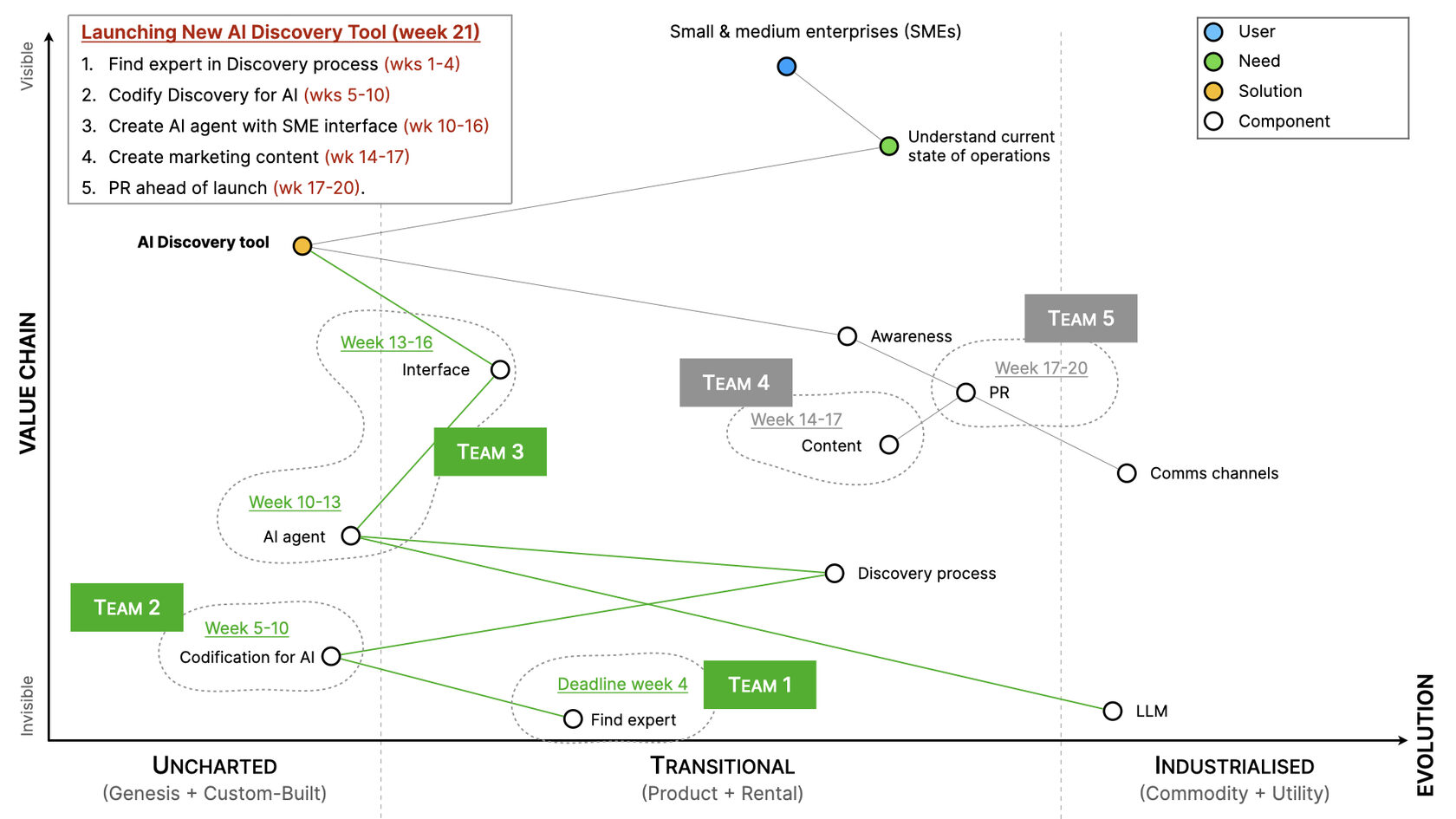
To make operational plans clear, we highlight the next 3 to 5 critical things that need to be done to achieve success (see figure 14). This enables everyone to see what matters, without being overwhelmed by details.
The map is central to our operational plan. It shows at a glance who is doing what, by when. It also reveals the dependencies between teams: who relies on whom.
If deadlines slip the responsible team can update others through the map, who can adjust their schedules appropriately. If leaders can’t let a deadline slip, they can step in and see what’s needed to deliver on time.
Figure 14: Maps as part of the Operational Plan.
Takeaway
A capable, cross-functional coordination team guides teams to turn stratagems into action — mapping out the information, resources, and support needed to deliver on operational objectives.
Operational plans give leaders a clear overview of what is happening across the entire business, while giving teams the flexibility they need to adapt in real-time.