Imposing one's will on reality has long been considered the hallmark of the strategic genius. But in today’s more complex and uncertain business environments, this is impossible for almost every leader.
That’s why so many choose to focus on the things they can control instead. Launching new initiatives, adopting the latest technologies, making detailed plans that feel concrete and measurable.
Yet, value is created outside the organisation by satisfying the needs of paying users. And users don’t care what we do — they only care about what we can do for them.
Seeking the Truth of the Current Situation
Some leaders shrink the world to their level of understanding — so they can deal with it the way they wished it was, rather than the way it is. They take past data and project it on to an uncertain future in order to make comforting predictions and devise plans that feel water-tight. But this is an illusion of certainty and control.
Other leaders raise their level of awareness to understand what’s really happening around them. Tapping into collective knowledge they see the world through the eyes of multiple others — inviting them to challenge assumptions and point out what’s missing or wrong. It’s uncomfortable — but it grounds them in reality.
Collective knowledge is the greatest untapped resource in organisations, as it’s always greater than the knowledge of any individual within it. By seeing the world through multiple perspectives we draw on our natural human abilities — honed over millennia — for navigating uncertainty effectively.
Turning Theories into Action
Tapping into collective human knowledge also means accessing the industry experience of our teams that can be measured in centuries, or longer. This combined power — used well — can be used to identify emerging threats and opportunities the organisation can leverage to shape conditions to its advantage.
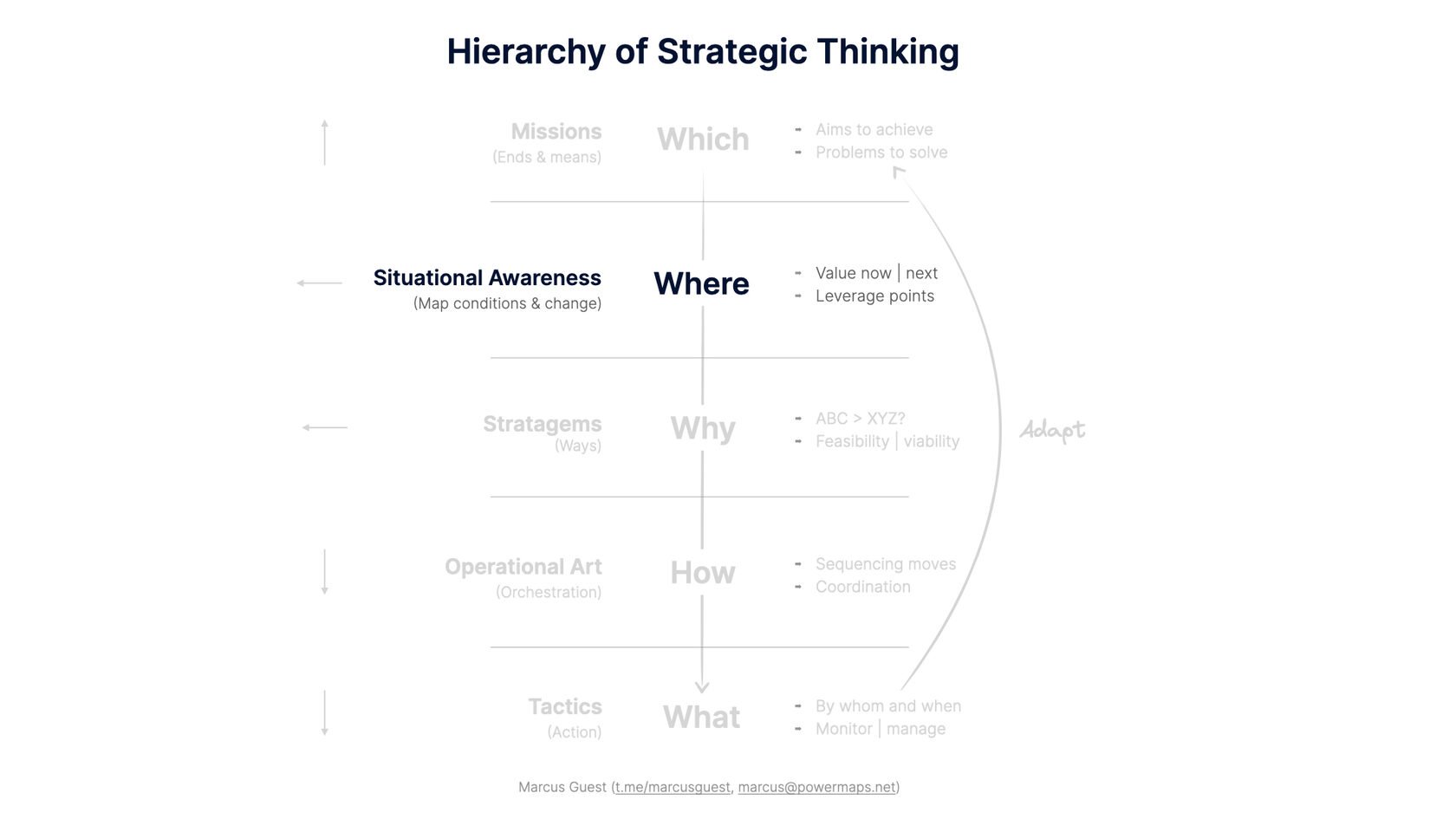
Situational awareness — the art of understanding what’s really happening in our surroundings, how it’s changing and why — brings harmony. The future remains a foreign land — wrapped in the uncertainty of the unknown — but with a shared map of our landscape we can identify what to do next.
New ideas will need to be tested — using data to verify our logic, rather than replace it — and run in live situations to gather the rich, thick data from interactions with users from which we learn and adjust. This is how we tap into the potential: engaging with how the world really — not just how we wished it was.
Quick Test
Ask yourself:
If you were forced to react you may be relying on the wrong sort of intelligence for decision-making.
What Next?
Developing situational awareness with the strategist’s most powerful tool — a map.
To follow this series join the Telegram channel t.me/wardleymapping
Or subscribe to the blog https://powermaps.net/blog
If you found this post useful consider sharing it with others.
And if you’d like to think and act strategically in your organisation explore more here: https://powermaps.net
That’s why so many choose to focus on the things they can control instead. Launching new initiatives, adopting the latest technologies, making detailed plans that feel concrete and measurable.
Yet, value is created outside the organisation by satisfying the needs of paying users. And users don’t care what we do — they only care about what we can do for them.
Seeking the Truth of the Current Situation
Some leaders shrink the world to their level of understanding — so they can deal with it the way they wished it was, rather than the way it is. They take past data and project it on to an uncertain future in order to make comforting predictions and devise plans that feel water-tight. But this is an illusion of certainty and control.
Other leaders raise their level of awareness to understand what’s really happening around them. Tapping into collective knowledge they see the world through the eyes of multiple others — inviting them to challenge assumptions and point out what’s missing or wrong. It’s uncomfortable — but it grounds them in reality.
Collective knowledge is the greatest untapped resource in organisations, as it’s always greater than the knowledge of any individual within it. By seeing the world through multiple perspectives we draw on our natural human abilities — honed over millennia — for navigating uncertainty effectively.
Turning Theories into Action
Tapping into collective human knowledge also means accessing the industry experience of our teams that can be measured in centuries, or longer. This combined power — used well — can be used to identify emerging threats and opportunities the organisation can leverage to shape conditions to its advantage.
Situational awareness — the art of understanding what’s really happening in our surroundings, how it’s changing and why — brings harmony. The future remains a foreign land — wrapped in the uncertainty of the unknown — but with a shared map of our landscape we can identify what to do next.
New ideas will need to be tested — using data to verify our logic, rather than replace it — and run in live situations to gather the rich, thick data from interactions with users from which we learn and adjust. This is how we tap into the potential: engaging with how the world really — not just how we wished it was.
Quick Test
Ask yourself:
- In the last 12 months, did anything surprise you in your market?
- Did you see this early enough and respond in time, or were you forced to react too late?
If you were forced to react you may be relying on the wrong sort of intelligence for decision-making.
What Next?
Developing situational awareness with the strategist’s most powerful tool — a map.
To follow this series join the Telegram channel t.me/wardleymapping
Or subscribe to the blog https://powermaps.net/blog
If you found this post useful consider sharing it with others.
And if you’d like to think and act strategically in your organisation explore more here: https://powermaps.net