In an AI world your organisation faces a choice. Outsource what you do to a machine that never needs a break, or asks for a pay rise. Or use machines to help your people do things they couldn’t before. The choice is whether to be more ‘token-centred’ or ‘human-centred’.
‘Token-centred’ means looking for the best models — the best LLMs or AI agents — to replace people in delivering your products or services today. The cost savings promise to be enormous. And you can’t afford to ignore this, especially if your rivals are doing it.
‘Human-centred’ means using technology to augment your people rather than automating them away. They will off-load repeatable tasks to AI, check them for accuracy, and focus on creating new sources of value that your competitors cannot easily copy.
To help you choose we’re going to use a Wardley Map — a visual tool showing how your organisation creates value today, and how that’s changing next.
Map 1: A Generic Wardley Map
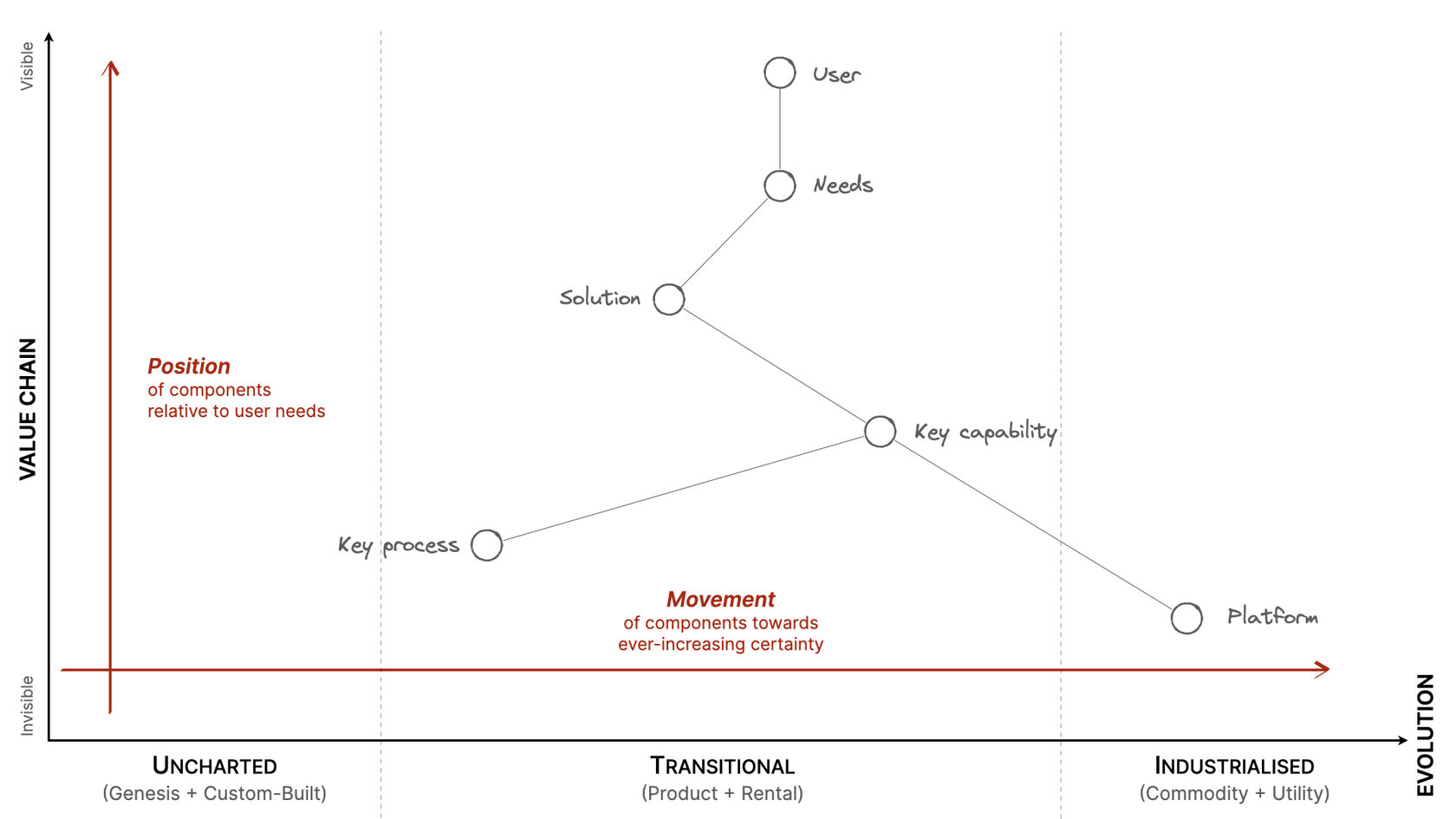
We place our users at the top of a Wardley Map map because we create value by satisfying their needs. We do this using components — controllable assets like solutions, capabilities, processes or technologies. The higher up the map a component sits, the more visible it is to users and the more they value it.
The horizontal axis shows how evolved each component is in your market. On the left is the uncharted stage, where components are new and uncertain. On the right is the industrialised stage, where they’re a cost of doing business. The middle is the transitional stage of products and services.
Now that you have a map of your landscape, you can make choices about how to play the AI game.
Map 2: AI Changes the Landscape
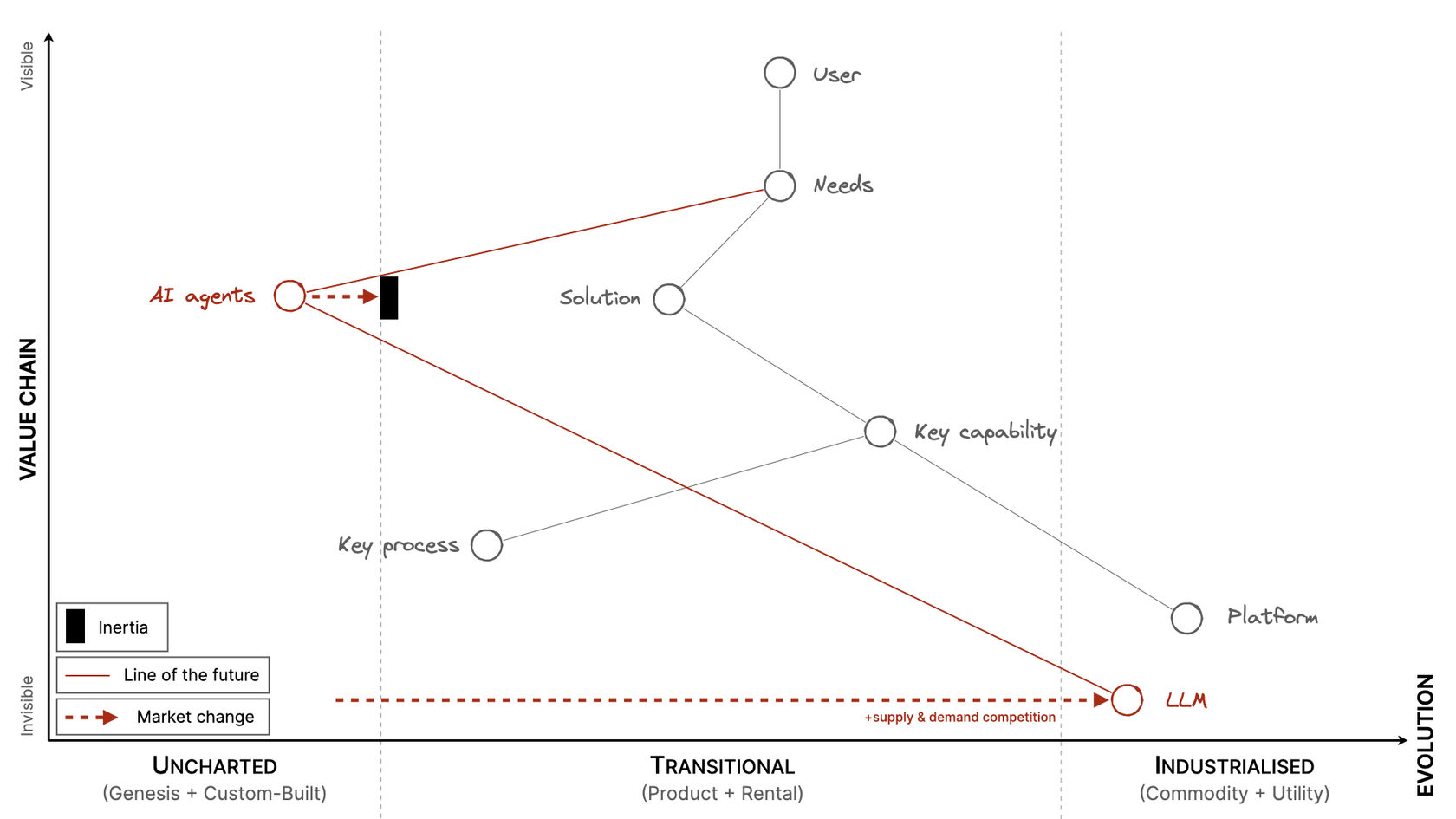
Large Language Models (LLMs) are an industrialised component today. They’re capable of doing many tasks faster and cheaper than people, so it’s tempting to outsource everything to them. But LLMs also hallucinate. They speak with total certainty, even when making things up. That’s why they require expert human oversight.
AI agents built on top of LLMs work on tasks independently, without the need for human prompts. The problem is, if everyone uses the same agents no-one gains a competitive advantage. AI agents are also in the uncharted space, meaning they’re new and have a lot of uncertainty about them. This contributes to their high failure rates and resistance — or inertia — to deploying them.
However, the biggest risk to being ‘token-centred’ is that AI agents are ‘black boxes’. Your organisation will enjoy cost savings today, but every task you hand over teaches the AI system, not your system. AI agents will create a lot of value tomorrow, but the companies providing them will capture this. You’ll be left with a dependency on a machine that creates no lasting value for you.
Map 3: ‘Back-of-house’ Approach to AI
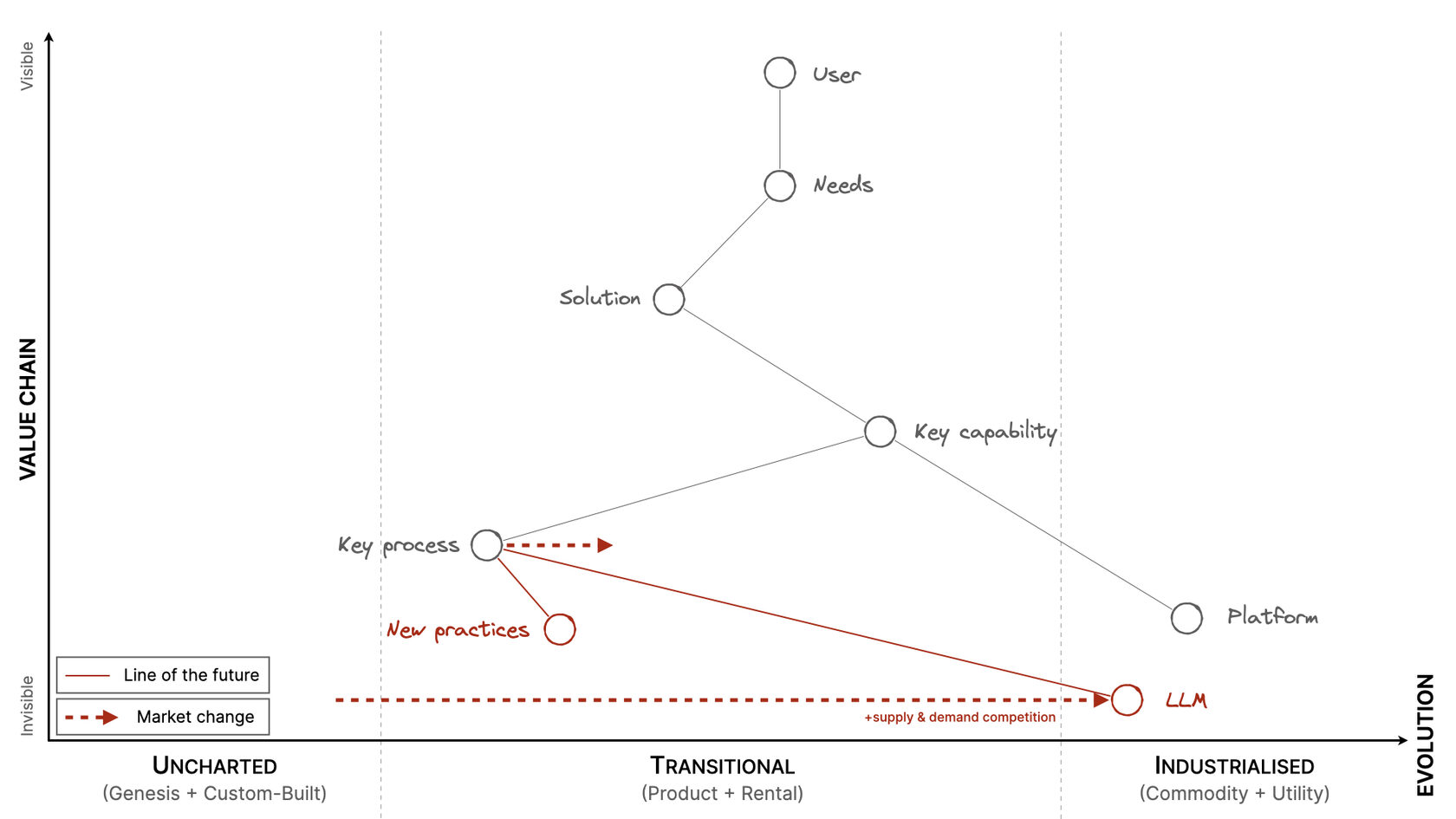
The alternative to being ’token-centred’ is being ‘human-centred’. Taking a ‘back-of-house’ approach to AI you connect components in your value chain — for example, a key process — to an LLM to enable your people can do more. Any failures are largely hidden from end users, minimising risks.
Your people will quickly discover the new hire is a ‘cretinous genius’ — able to produce outputs quicker and more thoroughly than any human, but blind to whether the task was worth doing in the first place. They will have to challenge the machine continually as it will habitually lie to them.
Your people will develop new practices for ‘working with the genius’ and ‘controlling the cretin’. They’ll root these practices in your organisation’s reality, making them your IP. Knowing how to harness new technologies, while minimising the risks, becomes the platform for your next moves.
Map 4: Creative Destruction
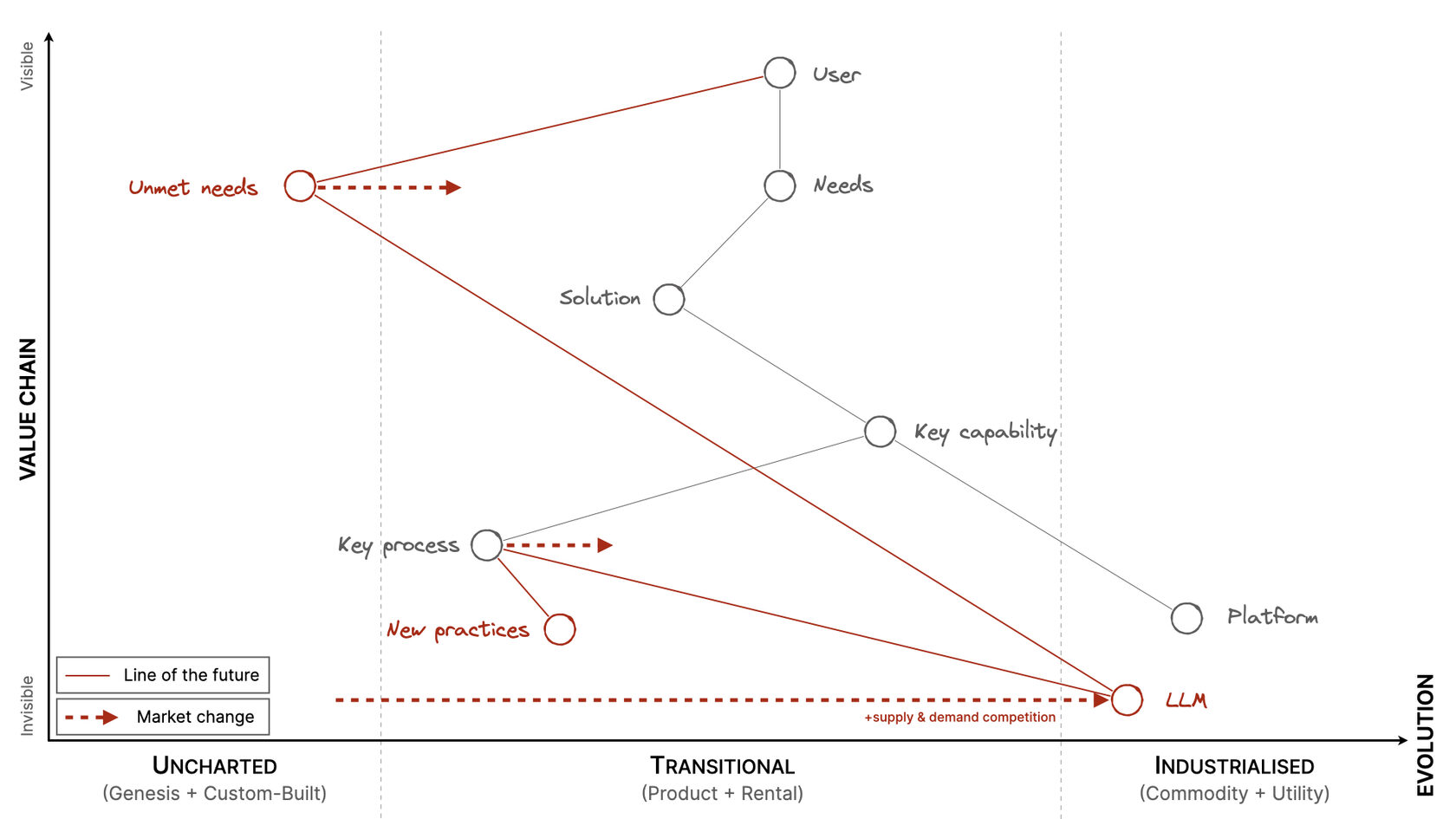
As a ‘human-centred organisation’ you resisted the temptation to simply replace your people with technology to do the same old things cheaper. Instead, you pushed your people to learn how to work with AI. You’ve developed an advantage that’s ready to deploy.
They developed an advantage that’s now ripe to deploy. Able to manage more work-streams with the aid of AI, they can simultaneously run current service lines whilst focusing on satisfying unmet user needs — needs that were deemed uneconomical to address before.
You start capturing these new sources of value — creating new lines of business and even markets. Capital and talent start to flow into the new, starving the old business models. You’re ahead of the curve — transformed into a new type of organisation for the world of AI. A digital centaur: part human — part AI.
Map 5: Past Pattern of Creative Destruction (Cloud)
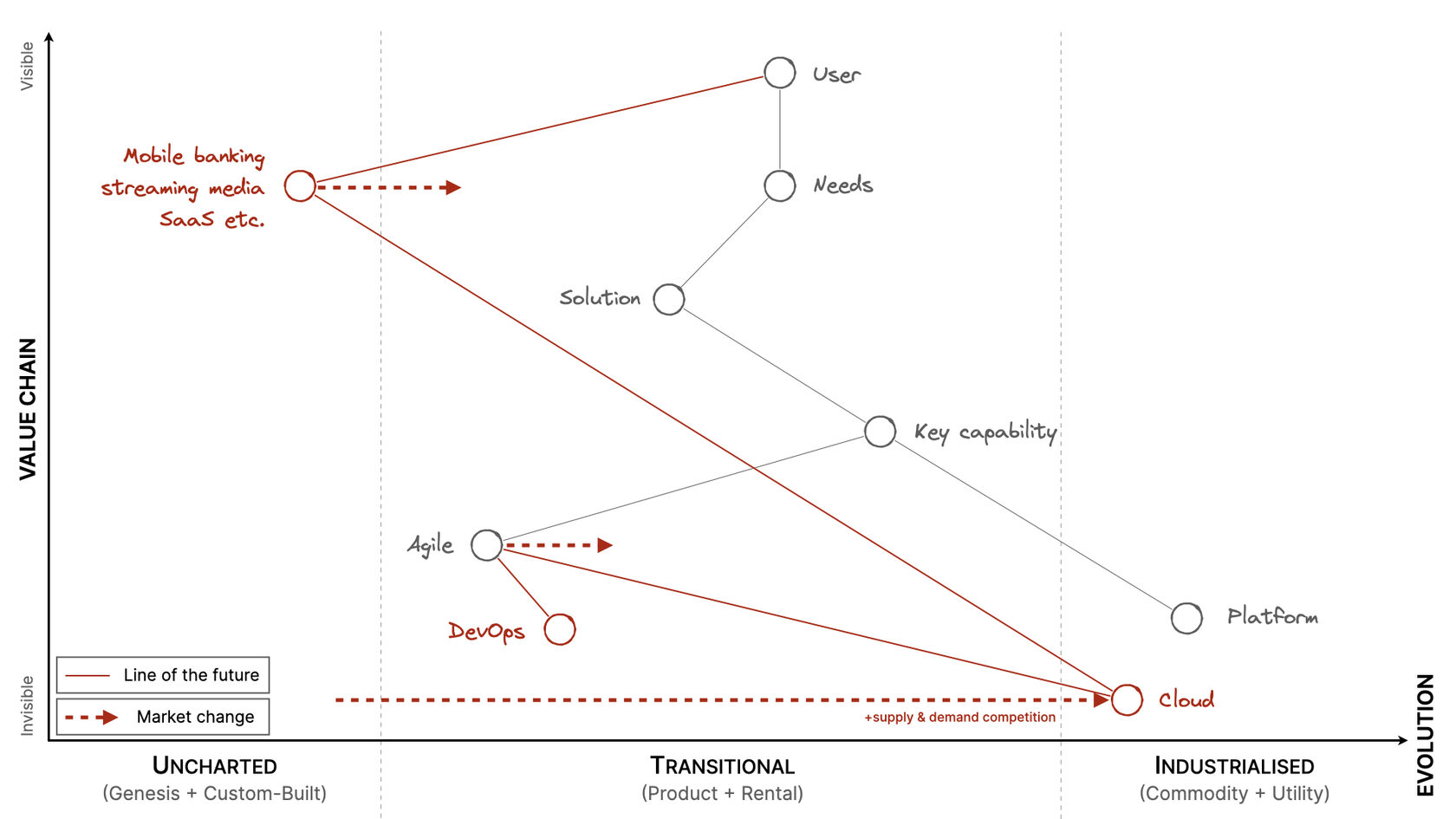
How do we know this will happen? Because it’s happened many times before.
The industrialisation of cloud computing at the start of this century pushed Agile practitioners — an emerging process in many organisations — to create DevOps. This new practice exploited the potential of what cloud computing made possible. The result was an explosion of new industries: on-demand ride-hailing, streaming media, mobile banking, marketplaces and SaaS.
A Wardley Map lets you see this pattern as it’s happening. It helps identify which ‘back-of-house’ components in YOUR value chain are ripe for AI. You can now choose where to be ’token-centred’ — seeking short-term efficiencies by replacing the human element in what you do. And where to seek the bigger prize that comes from being ‘human-centred’ — using AI to create tomorrow’s businesses.
Are you ready to find your path in the world of AI?