Forward-looking organisations accept that constant change will define their future. To manage it, they divide operations into three areas:
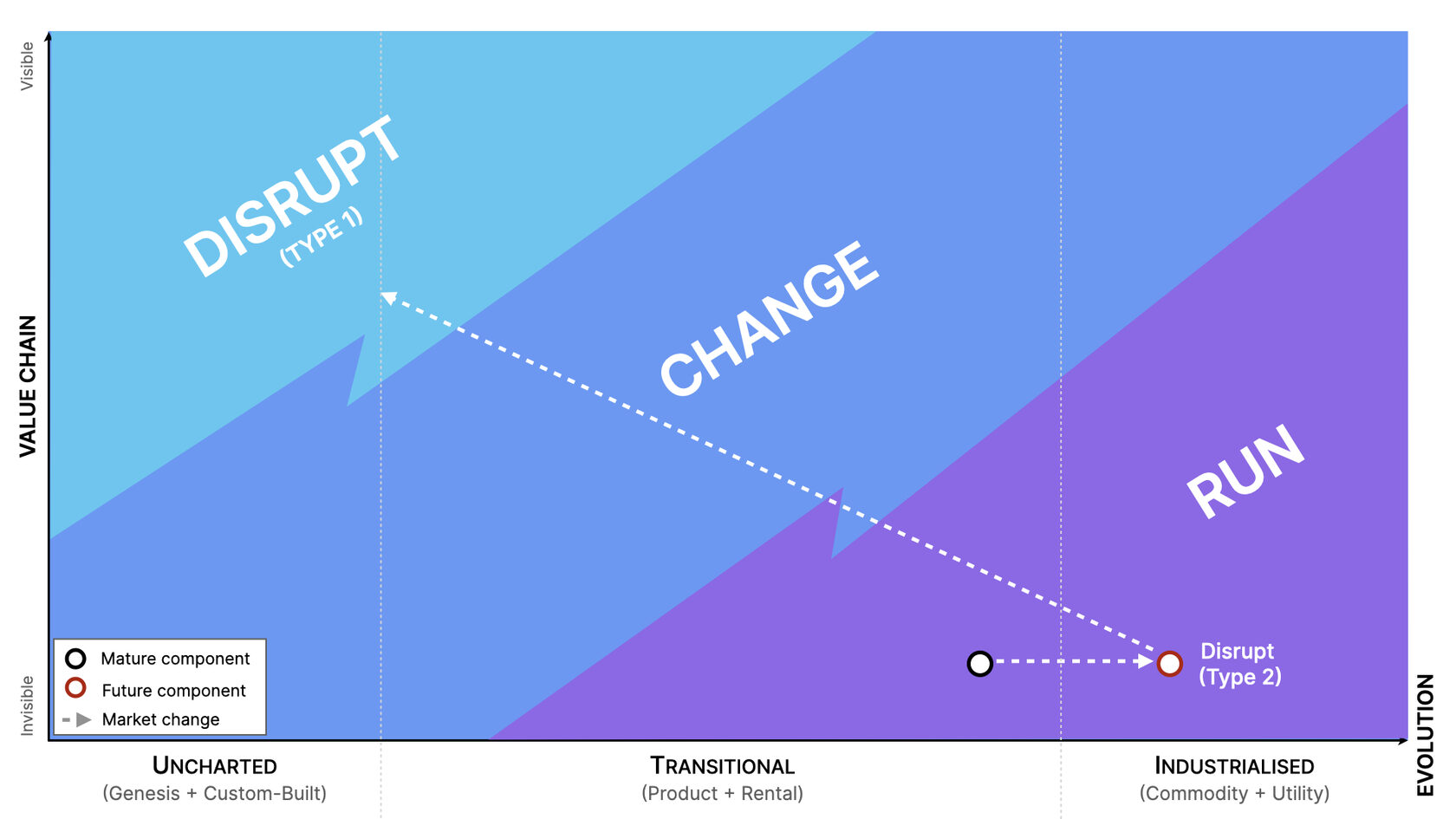
On a Wardley Map, this is beautifully clear:
But a Wardley Map reveals a more powerful type of disruption: Supply-side disruption (type 2).
When a mature “RUN” activity starts to become too costly, (e.g. because of increased usage) users look for alternatives. For example, companies once ran expensive on-premise data centres, until Amazon offered cloud computing as a cheaper, more reliable utility..
This freed up organisational talent to shift from managing infrastructure to exploiting the next wave of user-facing disruption (type 1) that was unleashed by the smartphone revolution — mobile banking, e-commerce, DevOps etc. — and reshaped entire industries.
So if you have a Wardley Map of your landscape, see if you can identify where mature, expensive "RUN" is ripe for disruption. If you don't have a map, it's likely the first “RUN” activity you're missing.
- RUN essential systems you can’t operate without.
- CHANGE existing products and processes to stay competitive.
- DISRUPT — create new sources of value that reshape the market.
On a Wardley Map, this is beautifully clear:
- RUN the mature, commodity-like components that sit bottom right.
- CHANGE the products and processes in the middle.
- DISRUPT at the top left, where innovation is visible and valuable to users.
But a Wardley Map reveals a more powerful type of disruption: Supply-side disruption (type 2).
When a mature “RUN” activity starts to become too costly, (e.g. because of increased usage) users look for alternatives. For example, companies once ran expensive on-premise data centres, until Amazon offered cloud computing as a cheaper, more reliable utility..
This freed up organisational talent to shift from managing infrastructure to exploiting the next wave of user-facing disruption (type 1) that was unleashed by the smartphone revolution — mobile banking, e-commerce, DevOps etc. — and reshaped entire industries.
So if you have a Wardley Map of your landscape, see if you can identify where mature, expensive "RUN" is ripe for disruption. If you don't have a map, it's likely the first “RUN” activity you're missing.