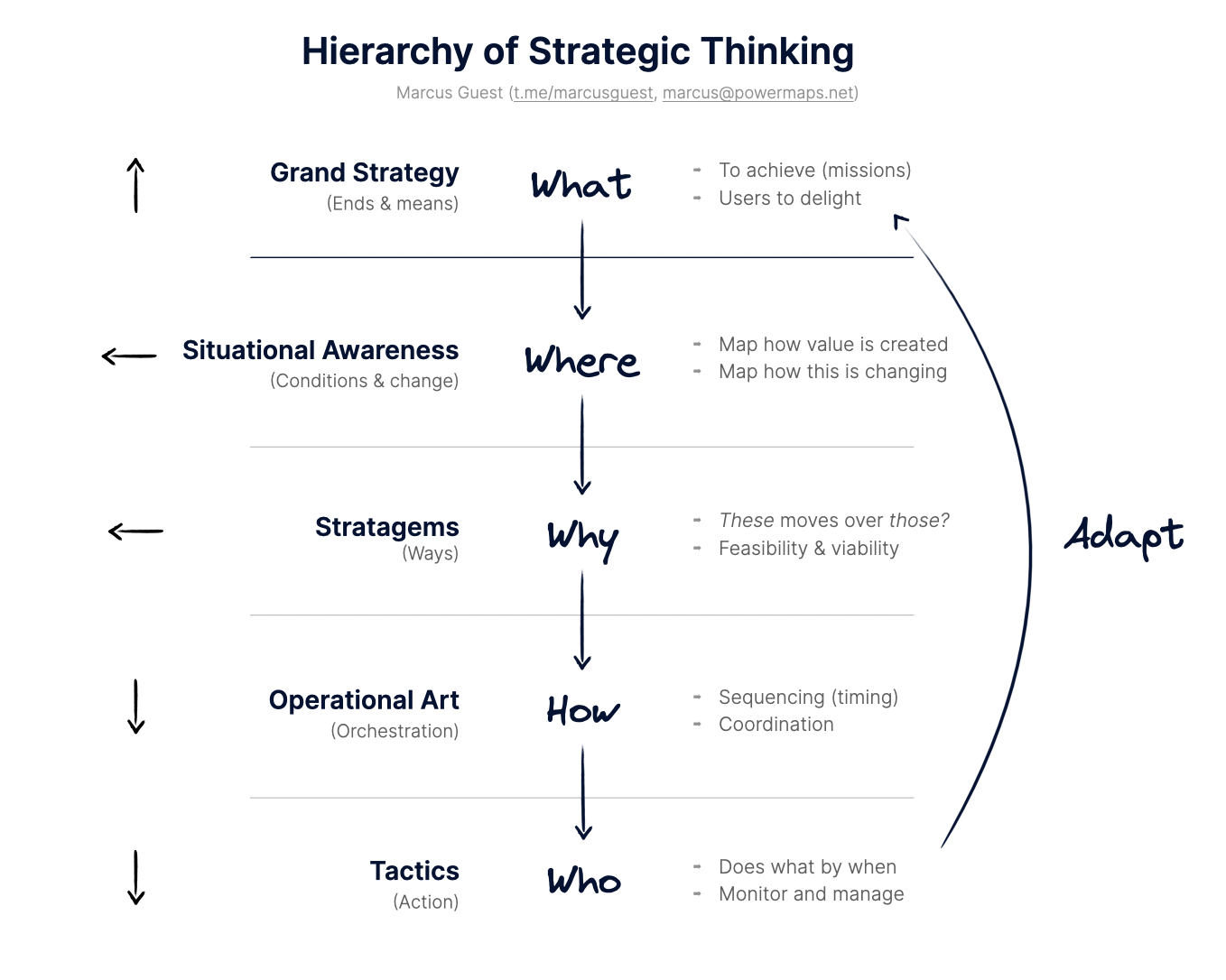
To demonstrate how better strategic thinking leads to more successful action, I’m going to show how the Hierarchy of Strategic Thinking (HST) can be applied across very different situations.
This example is about negotiating a major deal — for example, to end a geo-political stand-off.
This is what the HST provides: a clear path from strategic intent to coordinated action — enabling people to identify and make better moves as the situation unfolds.
If you want to explore how to deploy the HST in your organisation — get in touch
This example is about negotiating a major deal — for example, to end a geo-political stand-off.
- Politicians have an aim — end a trade blockade — and give their negotiators a clear mission: reopen access without conceding long-term advantage (grand strategy).
- The blockade is hurting both sides economically, but our rival faces greater political pressure to resolve it quickly. Escalation remains a real but undesirable outcome for both (situational awareness).
- Use time as a weapon: hold our position to build pressure on our rival, trading only limited concessions for movement on core objectives. Maintain support of allies through parallel engagement (stratagems).
- Negotiations are run in rounds, the timing of which we will control — setting agendas and pacing so pressure builds between sessions and each round strengthens our position (operational art).
- In the room, negotiators resist partial solutions and use delay — pauses, walk-outs, and consultations with leaders back home — to force movement at key moments (tactics).
- If pressure fails to shift our rival’s position, suspend negotiations to allow external pressure to intensify before re-engaging (adapt).
This is what the HST provides: a clear path from strategic intent to coordinated action — enabling people to identify and make better moves as the situation unfolds.
If you want to explore how to deploy the HST in your organisation — get in touch