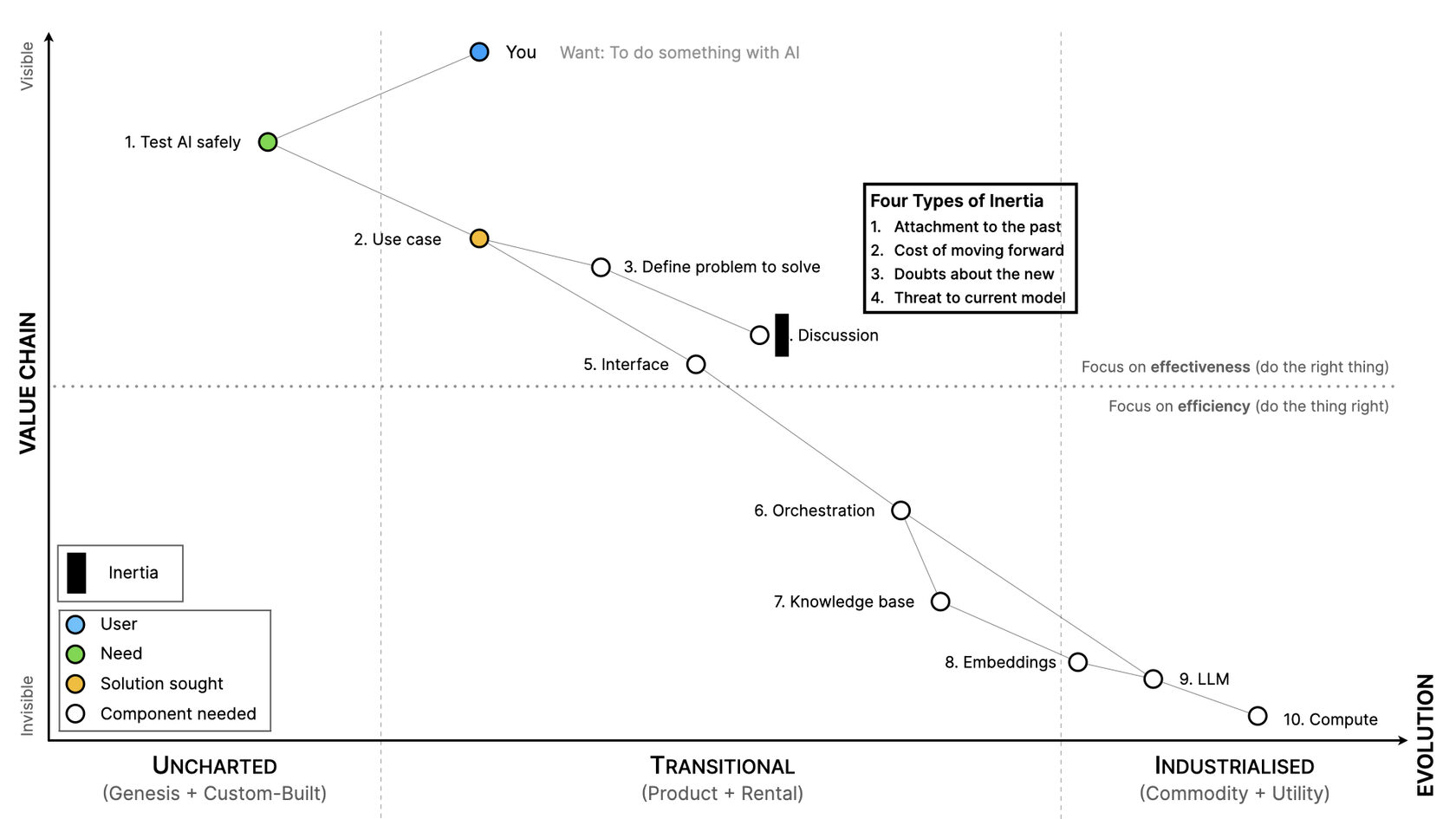
Our Wardley Map (attached) shows that the technical components of an AI implementation — interface, orchestration, knowledge base, embeddings, LLM and compute — are well evolved. There’s widespread certainty about them on the market, with suppliers knowing how to deploy these. So why are so many organisations — including perhaps yours — struggling to implement AI successfully?
The first problem is AI hype. Companies like OpenAI and Anthropic have done a fantastic job marketing their LLMs as the next big thing. This has led to many organisations feeling left behind if they don’t ‘do something with AI’ now — resulting in many adopting AI “solutions” to problems that haven’t been clearly articulated. This is a major reason why many AI implementations don’t deliver the value expected.
But AI hype doesn’t mean AI is all hype
LLMs, and the technologies and practices being built on top of them, are bringing value to multiple industries. AI excels on complicated tasks — those with clear right or wrong answers — that it’s able to complete quicker and cheaper than humans. People still need to check AI outputs for hallucinations — but industries like legal, health and banking are benefiting from AI’s ability to churn through data faster than people can.
Yet AI struggles with complex tasks — those where right or wrong answers don’t exist. Outputs here are more a matter of judgment as to what is good or bad. Humans excel at this, AI does not. Furthermore, as machines can’t be held accountable for bad decisions, AI has to remain in a support role in these instances. The promise of an AI agent thinking and acting independently is too big a risk here.
The biggest mistake organisations make is confusing complicated with complex tasks
‘Doing something with AI’ requires the organisation to first choose the right type of ‘use case’ (component #2 on our map) to focus on. For example, reducing the time your legal team spends reviewing contracts is a complicated challenge AI excels at. The rules are knowable, right answers exist, and AI can review thousands of contracts in the time it takes a human to read one.
But if your chosen ‘use case’ is a complex one the challenge is very different. For example, preventing a client from leaving requires context and judgement, not just data and processing power. An AI can surface patterns from your data about your client, but a human has to decide which of those patterns are meaningful. Complex challenges require solutions unique to your context — not blind application of common patterns.
Your first step therefore in implementing AI successfully is to ‘define the problem to solve’ (component #3). But don’t let AI providers define this for you (“We reduced your rival’s costs by 27%. Shall we do yours?”). AI draws on information from your ‘knowledge base’ (component #7), which is different from your rivals’. The only guarantee you have is that different inputs will produce very different results.
Focus instead on determining the problem to solve yourself. Have a frank and honest ‘discussion’ (component #4) with people who are knowledgeable about the situation and have some ‘skin in the game’. Yet discussing something as unfamiliar as AI reveals another real problem — one that also contributes to many failed implementations.
Four types of resistance to the new (inertia)
Humans have a natural aversion to uncertainty — something I’ve written about before1. In an uncertain situation, threats can't be calculated as the data doesn't exist. This triggers a fear of loss — of status, power, resources, or the key relationships developed over time. People may seek to protect against these potential losses by pointing to instances of AI failures2 and arguing that ‘now is not the time to experiment’.
Resistance to the new — inertia — must be countered. AI may be hype, but it’s not only hype. You need to experiment and develop your capabilities for working with AI or risk falling behind. This requires choosing the right type of challenges for AI — complicated ones — and overcoming common patterns of inertia. Start by identifying which of the four causes of inertia you’re facing, then deploying appropriate countermeasures:
- Attachment to the past — Inertia here arises from fears about losing power: sunk costs, trusted supplier relationships and the lowering of barriers to entry. Counter this by reminding people that everything evolves and we either adapt or die. People will also need to see their role in this future.
- Cost of moving forward — Inertia arises from uncertainty about the skills needed tomorrow and the costs of acquiring them, as well as the erosion of the ‘best practices’ that senior people have risen on. Counter this by pointing out that this is a naturally recurring cycle and delay means costs rise further.
- Doubts about the new — Inertia arises from questions about the reliability of the new and whether you’ll become over-reliant on powerful suppliers. These are valid concerns. Counter this by favouring open source models and negotiating contracts to prevent supplier over-reach.
- Threat to current model — Inertia also comes from data showing the current model is successful, and the fact that people’s bonuses are tied to hitting those targets. Counter this by diversifying activities to avoid relying on past models and redesigning people’s rewards appropriately.
Discussions throw up objections and reveal uncertainties that leaders can’t easily contend with. This is why so many organisations avoid the honest ‘discussions’ they need to have about AI. Wardley Mapping exists for this purpose: to help you see your current landscape more clearly, understand how it’s changing, where your options for action are, and how to overcome the inertia holding you back.
The next posts will apply maps to numerous industries to understand how organisations can implement AI.