What lessons could British manufacturers have learned from the eastern approach to strategy when facing down a competitive threat from an up-and-coming player like Honda?1 Fortunately, for those who love case studies, we don’t have to speculate. A decade later, Honda were the incumbent whose market dominance was being challenged by an insurgent player. What became known as the ‘Honda-Yamaha war’ provides insights into how the strategic game is played in the East.
In 1981, Yamaha opened an enormous new factory that, when running at full capacity, would make them the world’s largest motorbike manufacturer. Their main problem was that Honda held this title and weren’t going to relinquish it without a fight. Facing a massive competitive threat, market leaders often choose to defend (or conserve) their position by launching an efficiency campaign to cut costs and maintain profitability, or lobby the government to seek protections, emphasising their importance as a major employer and tax contributor.
Yet defensive moves lack any compelling vision of the future. This can be fatal for a market leader as it hinders their ability to attract the top talent or sufficient capital needed to mount an effective response. Defensive moves make a company look like a “dead player — incapable of doing new things”1 — undermining their image as a leader. Honda though, as we’ve already seen, were a “live player — able to do things they have not done before”. Instead of simply defending their position, they went on a massive counter-attack with the battle cry: “Yamaha wo tsubusu!” (“We will crush Yamaha!”).
Direct and Indirect Attacks
An attack can take two forms: direct or indirect. Honda building an even bigger factory would have been a direct attack. But this would have been costly. It risked oversupplying the market, triggering a catastrophic price war, damaging profitability across the industry and resulting in massive layoffs. Honda made some direct attacks — cutting prices, outspending Yamaha on marketing, and flooding distribution channels — but such moves were part of a broader indirect attack that created “the opportunity for real growth"3 at the same time.
In a whirlwind 18 months, Honda launched a huge variety of new motorcycle models — 113 in all, nearly double their previous lineup of 60 (the same as Yamaha’s). Each new model featured more sophisticated technology, and Honda actively listened to what users thought about the new motorbikes, incorporating insights into subsequent iterations. This massive, real-time testing campaign not only enabled Honda to learn about customer preferences, but also to start shaping them as well. Honda “succeeded in making motorcycle design a matter of fashion, where newness and freshness [were] important to customers."4
Yamaha simply couldn’t keep up. In response to Honda’s 113 new models, Yamaha launched just 37. Soon, “next to Honda’s motorcycles, Yamaha’s bikes [began to look] old, out-of-date, and unattractive”. Sales plummeted, and they struggled to sell motorbikes even below cost, leading to soaring inventory overheads. Eventually, Yamaha had to make a humiliating public climb-down: “We want to end the H-Y war. It is our fault,” declared Eguchi, Yamaha’s president. “We cannot match Honda’s sales and product strength. Of course there will be competition in the future, but it will be based on a mutual recognition of our respective positions”.
Honda’s successful indirect attack also came at a cost. Significant investment would be required to get them back on a ‘stable footing’. But, “so decisive was its victory that Honda effectively had as much time as it wanted to recover. It had emphatically defended its title as the world’s largest motorcycle producer and done so in a way that warned Suzuki and Kawasaki not to challenge that leadership. Variety had won the war”.
Fig.14: Honda Pushed the Frontier of the ‘Requisite Variety’ of Responses Needed to Crush Yamaha
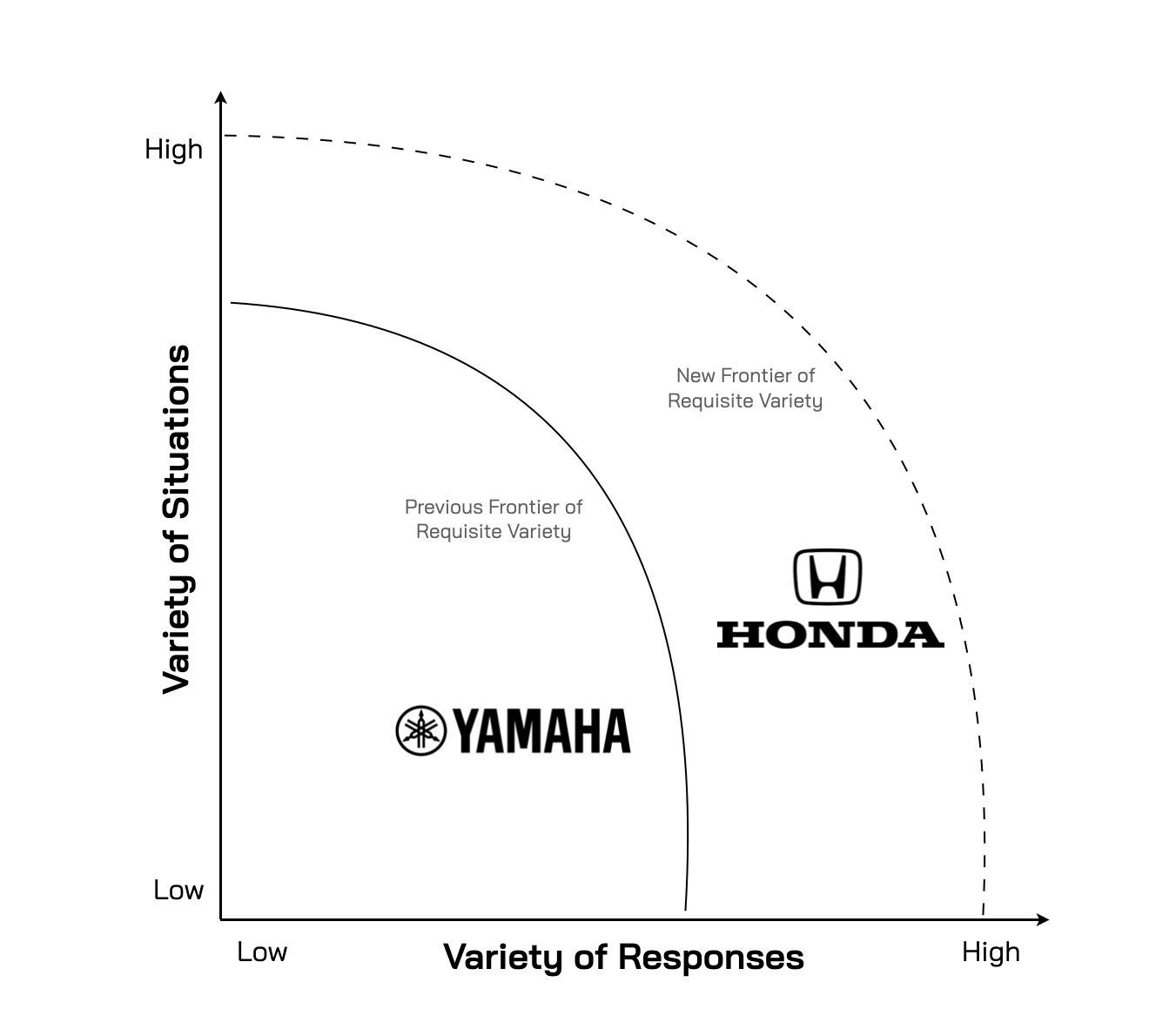
Honda were able to respond so devastatingly to Yamaha’s threat as they’d spent years embracing new ideas and technologies and experimenting with new practices, such as flexible factories. They’d built a requisite variety of potential responses8 in advance. Honda also understood, as Pal’chinskii9 did before them, that the latest technology alone is insufficient for victory. Their success over Yamaha came from how they tapped the increased flows of information coming in from customers through effective feedback loops, enabling them to quickly select what was working in their local context. Each new motorbike launch was more eagerly anticipated than the one before, creating a buzz Yamaha couldn’t compete against, despite its bigger factory.
Time as a Strategic Weapon
Speed alone doesn’t guarantee success. Grandmasters make more mistakes playing speed chess, where moves must be made in a limited timeframe, than in the longer form of the game. Faster moves aren’t necessarily better moves. But what Honda unlocked was a more powerful resource: they used time as “a strategic weapon [that was the] equivalent of money, productivity, quality, even innovation”.
Honda were able to adapt quicker than Yamaha by experimenting with a variety of ideas and getting information from the market through effective feedback loops — learning what it wanted (or didn’t, making failure a learning opportunity). Honda weren’t playing speed chess — they were rewriting the rules of the game, making several moves to each one of Yamaha’s. In such a lopsided game, even an average player would defeat a grandmaster.
Honda and Fujifilm acted in ways consistent with Pal’chinskii’s principles. While it’s unlikely either of these Japanese firms had even heard of the young Russian engineer, their unorthodox moves drew on a shared foundation — the eastern approach to strategy — a powerful way of creating a competitive advantage in uncertain times. We will explore this more deeply in the next chapter.
3 Unless otherwise indicated, quotes in this chapter are from: Time — The Next Source of Competitive Advantage. George Stalk Jr. HBR (July 1988)
4 Richards, Chet. Certain to Win: The Strategy of John Boyd, Applied to Business. Kindle Edition. Location 349