Uncertainty — a state of doubt regarding the future — is a “fundamental and irresolvable characteristic of our lives."1 It’s also a powerful teacher, for those willing to learn its hard lessons. One country that has experienced more than its fair share of uncertainty is Russia. And one of the lessons it is learning comes from the most famous Russian that most Russians have never heard of — Petr Pal’chinskii.2
Petr Pal’chinskii was a bright, confident and almost absurdly honest engineer. In 1901, at the age of 26, he was sent to the Donbass to study the modernisation of Russia’s coal mines. Gathering data on everything he could, he uncovered a huge gap between investment in new mining technology and investment in the living and working conditions of miners.
Pal’chinskii reported back to the government in St. Petersburg, arguing that true modernisation required investing in the workforce as well. His reasoning was that investments in new technology are ineffective if workers are unable or unwilling to use it. Improving the living and working conditions of miners, so they are both capable and motivated to use the new technology productively, would generate far greater returns than investing in technology alone.
Pal’chinskii’s report caused a political scandal in St. Petersburg, eventually leading to exile in Siberia. After a few years he escaped to Europe, where his ideas of seeing technical problems in their social and economic contexts gained traction. Major European ports in Amsterdam, London, and Hamburg saw significant productivity gains by applying his ideas. Better cranes and warehouses were not enough. Workers also needed the right skills and incentives. Pal’chinskii wrote up his methods in a four-volume study and toured Europe to spread his ideas, becoming famous.
Fig.8: Petr Pal’chinskii at a Trade Fair in Turin, Italy (1911)
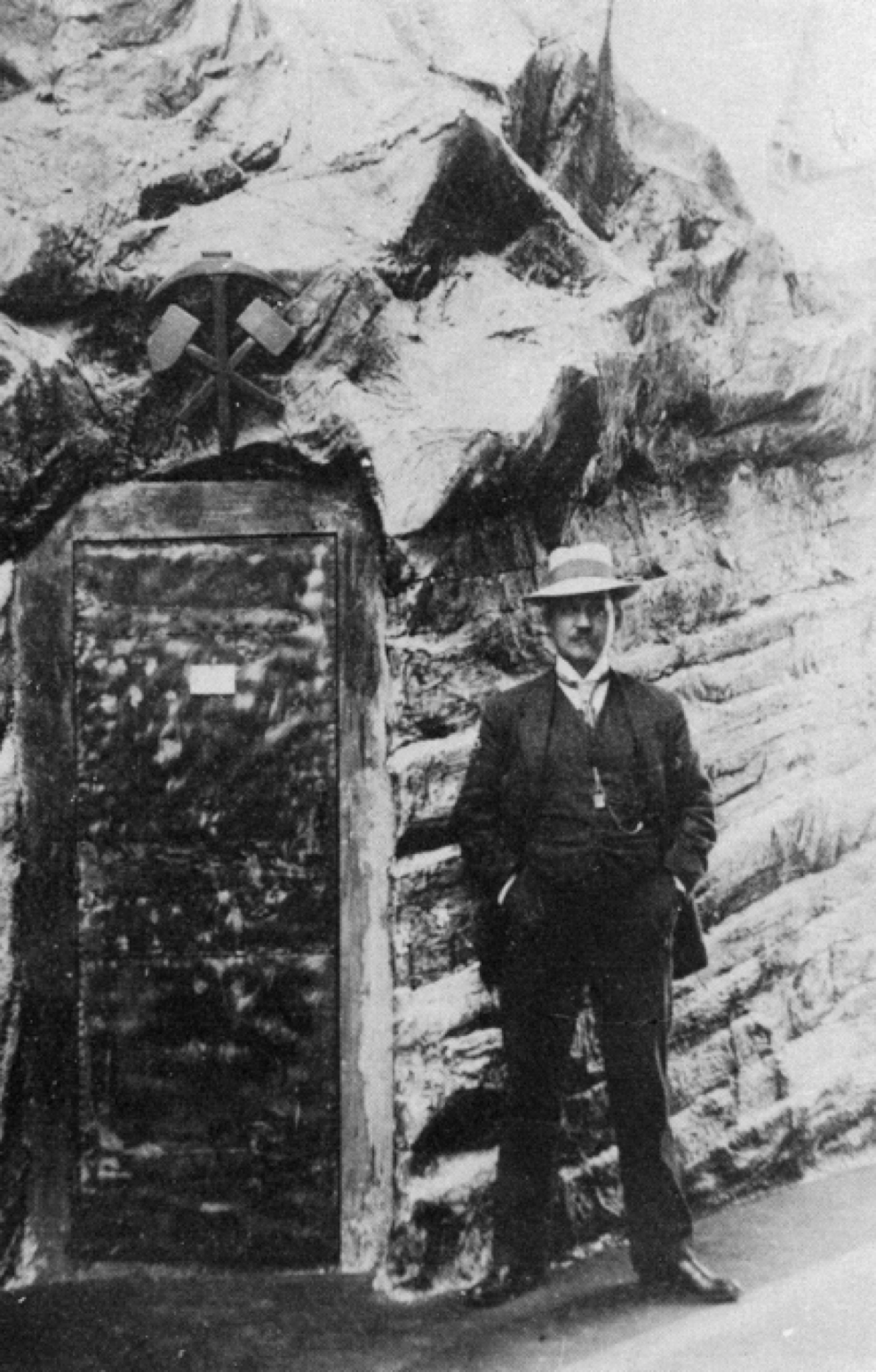
Petr Pal’chinskii at the exhibit he arranged for a manufacturing and mining trade fair in Turin, Italy, in 1911 . Above the mine shaft entrance is the Russian mining engineers' symbol. Source: The Ghost of the Executed Engineer
In 1913, after receiving a royal pardon, Pal’chinskii returned to a politically turbulent Russia. The government of the embattled Tsar had launched a modernisation drive to try to conserve royal power, and Pal’chinskii became an adviser. Yet, his uncompromising honesty continued to court controversy. He criticised the government’s obsession with “disruptive technologies”, pointing out that “graduates of Russian engineering schools think that every problem is a purely technical one, and they assume that any solution that incorporates the latest science is the best solution."3 Though an avid reader of foreign technical literature himself, Pal’chinskii sought guiding principles that would help tailor those technologies to Russia’s unique conditions, rather than trying to copy ready-made ‘solutions’. Pal’chinskii argued that, if decision-makers could learn to see technologies as part of the local context, rather than apart from it, Russia could become a competitive force globally.
After the October 1917 revolution and a brief spell in prison, Pal’chinskii was invited to advise the new Soviet government on its modernisation program. This was the time of ‘gigantism’: massive prestige projects such as Dneprostroi, a major hydroelectric station; Magnitostroi, a major steel mill; and the White Sea Canal, connecting the Baltic and White seas. The absurdly honest Pal’chinskii criticised these projects fiercely, arguing they would only succeed if there was an abundance of both highly skilled workers and cheap energy locally — both of which were lacking.
He proposed alternative model of modernisation, grounded in an understanding of local conditions, guided by three key principles:
- Experiment with a variety of ideas to increase the chances of success.
- Accept that some failure is inevitable,4 so keep projects small enough that any failure is survivable.
- Develop effective feedback loops between decision-makers and those closest to the action, to quickly identify and select what works in the local context.
In 1926, Pal’chinskii published ground-breaking research supporting these principles. His meticulous data showed that the most productive Soviet enterprises were not those with the latest equipment, but those that utilised their workers best. He argued for a greater focus on the biggest “non-utilised force” the Soviet Union had — its eighty million workforce — in comparison to which, “all the other great natural riches of the country paled in significance."5 Utilising this correctly would “bring more fruits than anything else."6
Unfortunately, Pal’chinskii's views were increasingly out of step with the times. In 1928, he was arrested and, the following year, executed. Pal’chinskii paid the ultimate price for his honesty, but his principles today are a powerful guide for modern leaders, providing insights into how to navigate an uncertain world and adapt effectively. We’ll look at how to apply ‘Pal’chinskii’s Principles'7 over the next few chapters.
1 Quoting Boyd in ‘Science, Strategy and War. The Strategic Theory of John Boyd’. Frans P.B. Osinga (2007)
2 Based on the book ‘The Ghost of the Executed Engineer’ by Loren R Graham (1993)
3 ‘The Ghost of the Executed Engineer’. Loren R Graham p.14
4 Because everything breaks eventually: https://www.wired.com/2012/10/ff-why-products-fail/?cid=co9198914
5 The Ghost of the Executed Engineer. Loren R Graham (1993) p.97
6 The Ghost of the Executed Engineer. Loren R Graham (1993) p.38
7 Coined by Tim Harford in his 2011 book ‘Adapt: Why success always starts with failure’. p25