In late 2020, I had a meeting at the offices of a leading retailer. While waiting in their conference room, I noticed they had their strategy pinned to one of the walls, across three large sheets of paper. Here was a plan detailing the company’s vision, mission, values and key performance indicators (KPIs), with a GANTT chart showing project deadlines. It had clearly taken a lot of time to complete and, judging by the embossed logo of the high-profile strategy consulting firm stamped on the paper, a lot of money to create.
The executive arrived and sat down. I gestured to the strategy on the wall behind him:
Me: I was looking at your strategy. Quite the undertaking.
Executive: Mm
Me: How is it holding up under COVID?
Executive: It isn’t.
Me: Will you be hiring [the strategy firm] again for next year?
Executive: No. I think we need something different.
Executive: Mm
Me: How is it holding up under COVID?
Executive: It isn’t.
Me: Will you be hiring [the strategy firm] again for next year?
Executive: No. I think we need something different.
I couldn’t agree more. But what might that ‘something different’ be?
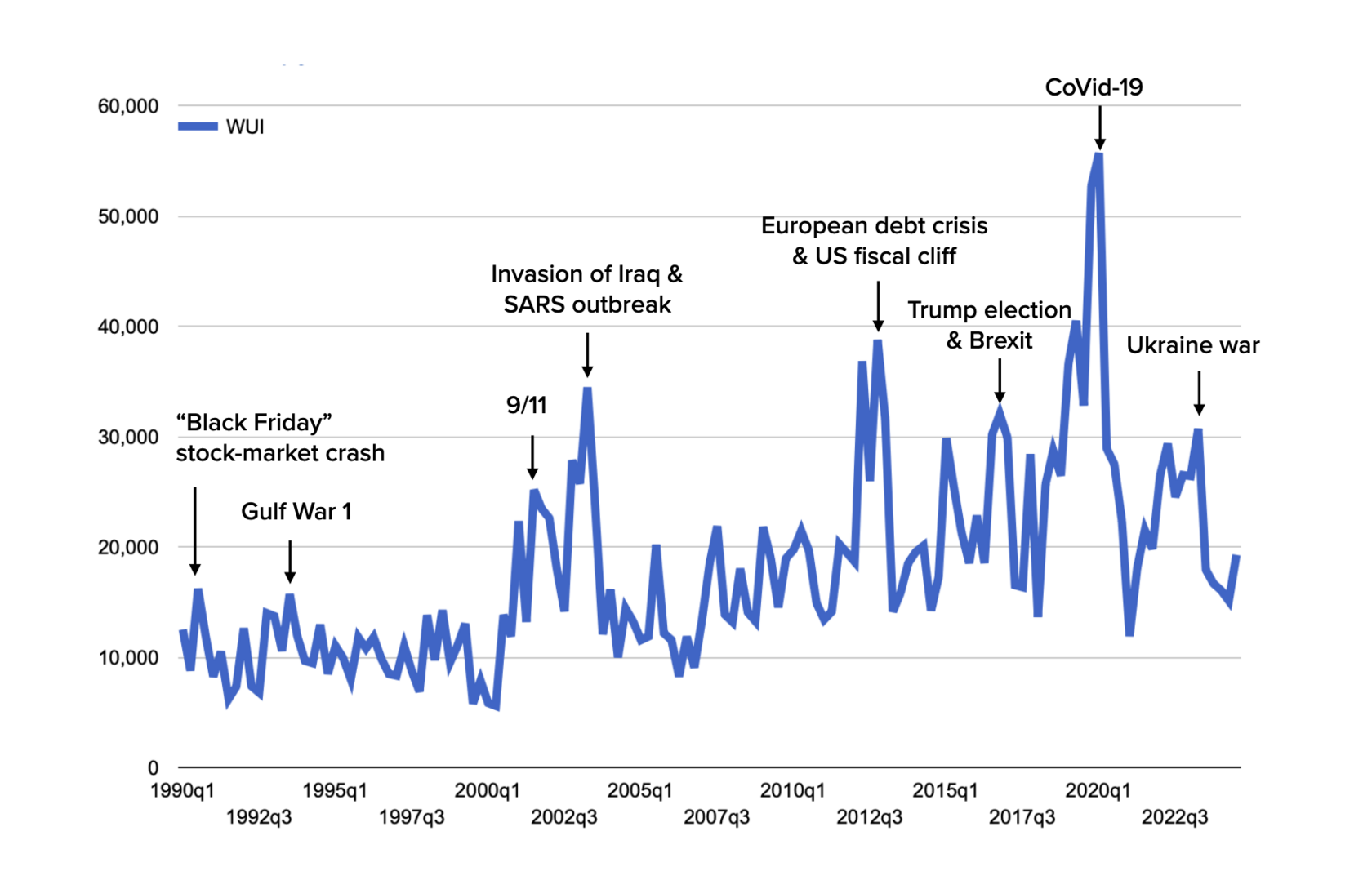
The World Uncertainty Index (WUI)1 measures the frequency of the word “uncertain” (or its variants) in Economist Intelligence Unit country reports. The higher the number, the higher the uncertainty, and the WUI suggests uncertainty is rising (see fig.3). Yet political turbulence, financial crashes, wars and natural disasters are not new. So why does uncertainty feel more acute today?
Part of the answer is that our modern ‘Age of Information'2 produces unprecedented amounts of data, which also carries vast noise obscuring the signals. This renders data:
Part of the answer is that our modern ‘Age of Information'2 produces unprecedented amounts of data, which also carries vast noise obscuring the signals. This renders data:
- Unreliable — questionable sources affect credibility.
- Ambiguous — open to multiple interpretations.
- Complex — challenging to integrate cohesively.
- Missing — unavailable or inaccessible when needed.
This is the information paradox: the more data, the more noise — and the greater the uncertainty.
Fig.3: World Uncertainty Index (WUI) 1990—2024(Q3)
Uncertainty Causes More Stress Than Pain
Humans instinctively avoid uncertainty for good evolutionary reasons — it was better our ancestors assumed the rustling of the grass was a predator and be wrong, than assume it was the wind and be wrong. An experiment at University College London also showed that uncertainty creates extreme anxiety in humans, affecting how we act.3
The university research team divided volunteers into three groups. Each was told they would play a computer game where they’d have to turn over rocks. If there was a snake underneath a rock, they’d receive “a mildly painful electric shock on the hand”. The first group was told there were no snakes under any of their rocks (0% chance of getting a shock). The second group was told there were snakes under half their rocks (50% chance of getting a shock). While the final group was told there were snakes under all their rocks, so they’d be shocked every time.
As the volunteers played, researchers measured their stress levels. The results were surprising. Volunteers in the first group (0% chance of getting a shock) were, unsurprisingly, the least stressed. Yet the volunteers in the second group (50% chance of getting a shock) were most stressed — even more than the third group (100% chance of getting a shock). “The most stressful scenario”, the researchers found, “is when you really don't know. It's the uncertainty that makes us anxious” rather than the inevitability of pain.
When uncertainty causes us stress, those who speak with certainty are comforting: economists who forecast future growth to two decimal places; futurists who declare which technologies will re-shape our future; and management consultants with pretty slides who explain how your company’s fortunes will experience a smooth upward curve if you adopt their recommended course of action. These ‘peddlers of certainty'4 — armed with big data and AI — provide a comforting illusion.5
The pursuit of certainty fuels the annual planning cycle in organisations. Executives and teams perform ritual steps — gathering and analysing data, brainstorming initiatives, determining strengths and weaknesses — and produce a ‘strategic plan’ that determines the organisation’s performance for the year ahead. The only uncertainty is in the execution of these well-laid plans. This has given rise to a cottage industry of KPI and OKR (objectives and key results) setters that promise to eliminate variance between plans and a messy reality.
This ‘assembly line’ approach — where known inputs produce knowable outputs — worked well in the ‘Industrial Age,6 where the main assets of production were large, predictable machines. But in the modern ‘Age of Information’, the key production assets are people, who are hard to predict and control. Coupled with cheap, ubiquitous computing and technological advances that have reduced barriers to entry in many industries, an explosion of new competitors has emerged from every corner of the globe, influencing consumer habits and accelerating the rate of change. And when our tightly-coupled supply chains are disrupted, they amplify shocks globally at devastating speed, undermining the best-laid plans of businesses.7
Yet ‘strategic planning’ not only remains the dominant way of “managing the organisation’s future but [for many] the only conceivable one."8
Yet ‘strategic planning’ not only remains the dominant way of “managing the organisation’s future but [for many] the only conceivable one."8
Problems With Strategy Today
The most striking finding from the University College experiment was the “potential benefit” of stress. “People whose stress responses spiked the most at periods of greatest uncertainty were better at judging whether or not individual rocks would have snakes under them”. The more stressed people became, the better their decision-making. Stress appears to be an evolutionary mechanism that heightens our awareness of what we should, or should not, do in unpredictable situations: “Appropriate stress responses might be useful for learning about uncertain, dangerous things in the environment” — increasing our ability to survive and thrive in a volatile world.
The essence of strategic thinking is learning about our environment — how it's changing and what opportunities and threats it presents. Yet, rather than using the heightened awareness stress triggers, many organisations prefer to create plans that try to predict the future in order to reduce stress. They focus on what they have in their control, such as costs. Departments submit lists of initiatives to take their share of a finite budget, often based on extrapolations from the past. Finance collates initiatives from across the organisation and forecasts revenue projections to produce targets everyone must chase down.
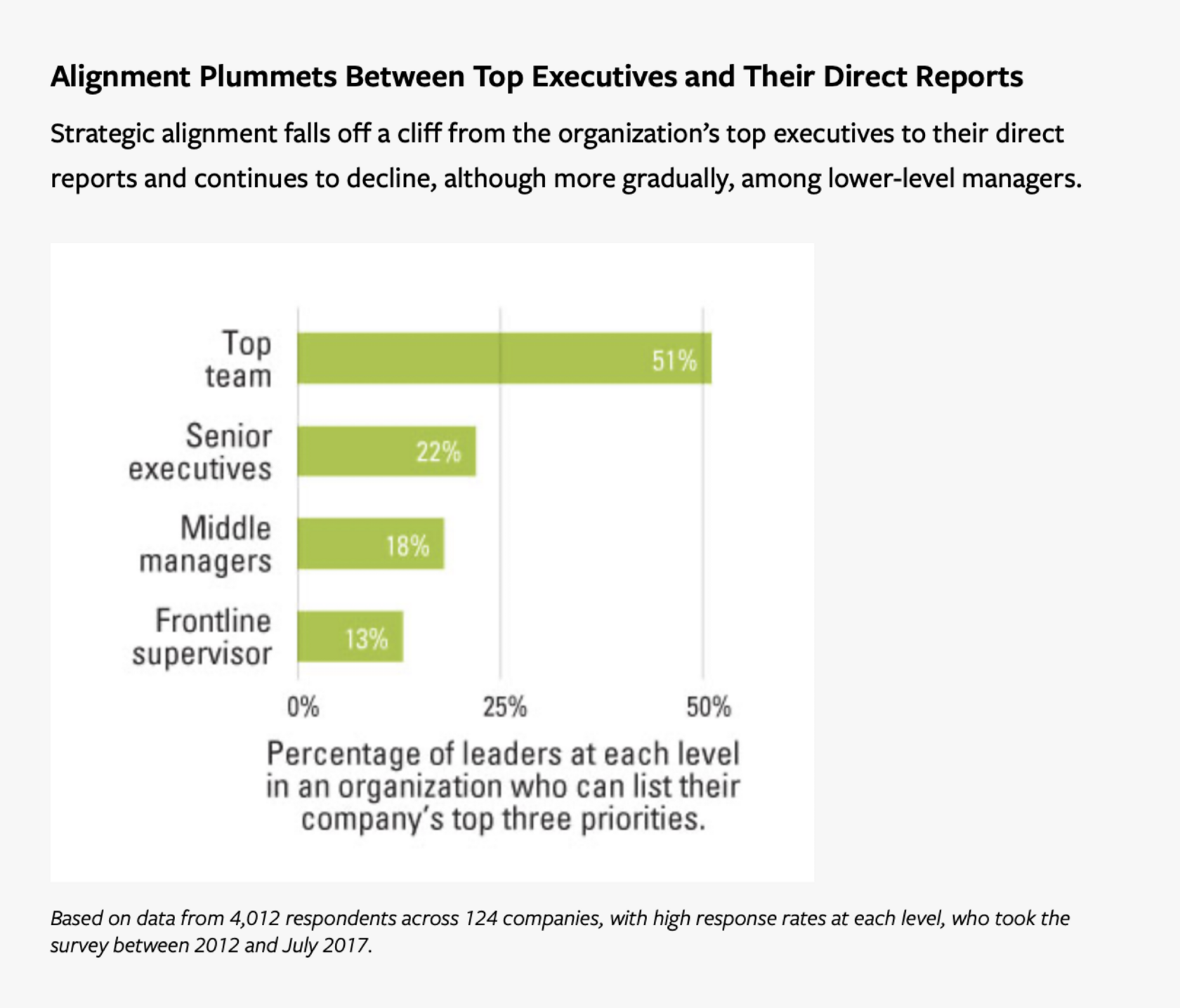
The ‘thinkers’ who created this ‘strategic plan’ roll it out to the ‘doers’ to implement. Yet, performance is not measured against the unfolding reality of the present, but against these guesses made in the past. As a result, average performance in better-than-forecasted market conditions is rewarded, whilst exceptional performance in worse-than-expected market conditions is penalised. Hitting targets forces people to be heads down all year. This is why most people — from frontline staff through to senior executives — can’t name their organisation’s top three strategic priorities (see fig.4). Half of ‘top teams’ — the ‘thinkers’ responsible for creating strategy — can’t either.
Fig.4: No One Knows Your Strategy — Not Even Your Top Leaders
The 2020s has shown that no amount of planning — regardless of how elaborate or data-driven — can predict the sharp discontinuities that impact us. Plans that bind us to a world we want to see leave us blind to the world actually unfolding, hindering our ability to adapt. Planners find it hard to admit their plans are faulty and the resources spent creating them wasted. Therefore, ‘sticking to the plan’ becomes an act of faith, a belief that, in the “hundreds of pages of analysis” and the “flowery prose that supplements the numbers in the budget”, there is something that’ll lead them to success. But the reality is that the entire planning cycle is mostly “a colossal bureaucratic waste of time."9
The limitations of ‘strategic plans’ have fuelled a new obsession: rigorous execution — epitomised in the words of JPMorgan Chase CEO, Jamie Dimon: “I’d rather have a first-rate execution and second-rate strategy any time than a brilliant idea and mediocre management”.10 While better execution sounds admirably pragmatic and action-oriented, it brings its own problems:
“When Hewlett-Packard announced disappointing results in August 2004, CEO Carly Fiorina stated, “The strategy is the right one. What we failed to do is execute the strategy.” Her explanation sounded reasonable, and no one questioned her when she swiftly replaced a few key executives — it looked like an appropriate step to improve execution and raise company performance. Curiously, when Fiorina herself was fired just six months later in February 2005, a company spokesperson repeated the same line: HP was following the right strategy, but the chief executive was replaced because the board of directors wanted better execution! Again, it all sounded reasonable, and no alarms were raised about the company’s basic choices. Six weeks later, when Mark Hurd was hired as the new CEO, Hewlett-Packard stuck to its message, announcing that it had “picked Mr. Hurd because of his execution skills.” And therein lies the problem: It’s always easier to bang the drum about execution than to address fundamental questions of strategy. It’s always easier to insist we’re going in the right direction but just need to run a little faster; it’s far more painful to admit that the direction may be flawed, “because the remedies are much more consequential."11
Rather than creating plans to reduce stress, or worshipping at the altar of execution, embrace uncertainty. Use the stress it triggers to improve awareness and judgment about what matters in business — customers. Customers are beyond your control — you can’t tell them what to do in the same way you can tell internal teams. But you can make choices about which customers to target, which needs to focus on, and how to satisfy those better than competitors. Customers don't care about your internal initiatives — they only care about what you can do for them. If you want to be successful, you should care about that too — because we create value for ourselves by creating something others are willing to buy.
It's time to stop making strategic plans. They are harming our ability to think and act strategically. Success in an uncertain world doesn’t require the right choices — just better ones than your rivals.
2 Starting around 1971 when the Intel microprocessor was announced.
3 “Computations of uncertainty mediate acute stress responses in humans”. Nature Communications. March 29, 2016. Discussed in ScienceDaily https://www.sciencedaily.com/releases/2016/03/160329101037.htm
4 Before the 2018 football world cup the Swiss investment bank, UBS, ran 10,000 simulations and predicted that Germany to win the world cup https://www.bloomberg.com/news/articles/2018-05-17/germany-will-win-the-world-cup-ubs-says-after-10-000-simulations
Then the US investment Goldman Sachs used AI to run 1 million simulations and predicted that Brazil would win the world cup in 2018: https://nordic.businessinsider.com/world-cup-predictions-pick-to-win-it-all-goldman-sachs-ai-model-2018-6?r=US&IR=T
Neither Germany nor Brazil even made it to the semi-finals, so Goldman Sachs re-ran its simulations with the four teams remaining and predicted Belgium would win it. Despite having a 1 in 4 chance Belgium also failed to make it to the final, which was won by France who beat Croatia: https://www.businessinsider.com/world-cup-predictions-goldman-sachs-ai-model-belgium-england-final?op=1
For a summary of this see: ubs-commerzbank-predict-germany-would-win-world-cup-wrong
Then the US investment Goldman Sachs used AI to run 1 million simulations and predicted that Brazil would win the world cup in 2018: https://nordic.businessinsider.com/world-cup-predictions-pick-to-win-it-all-goldman-sachs-ai-model-2018-6?r=US&IR=T
Neither Germany nor Brazil even made it to the semi-finals, so Goldman Sachs re-ran its simulations with the four teams remaining and predicted Belgium would win it. Despite having a 1 in 4 chance Belgium also failed to make it to the final, which was won by France who beat Croatia: https://www.businessinsider.com/world-cup-predictions-goldman-sachs-ai-model-belgium-england-final?op=1
For a summary of this see: ubs-commerzbank-predict-germany-would-win-world-cup-wrong
5 https://www.managementtoday.co.uk/why-need-turn-back-silver-bullet-solutions/opinion/article/1873247
6 Which was the Fourth Industrial Revolution if we consider the first as the Industrial Revolution (starting in 1771); the second Age of Steam and Railways (1829); the third the Age of Steel, Electricity and Heavy Engineering (1875); the fourth the Age of Oil, the Automobile and Mass Production (1908); meaning the current Age of Information and Telecommunications, starting in 1971 when the Intel microprocessor was announced in Santa Clara, California is the fifth Industrial age. Source: Technological Revolutions and Financial Capital. The Dynamics of Bubbles and Golden Ages. Carlota Perez (p.11)
7 “The best laid schemes o’ Mice an’ Men,
Gang aft agley,
An’ lea’e us nought but grief an’ pain,
For promis’d joy!”
— Robert Burns
Gang aft agley,
An’ lea’e us nought but grief an’ pain,
For promis’d joy!”
— Robert Burns
8 Rise and Fall of Strategic Planning. Henry Mintzberg (1994) p.60
10 Quoted in https://hbr.org/2010/07/the-execution-trap
11 The Halo Effect. Phil Rosenzweig (2007) p315