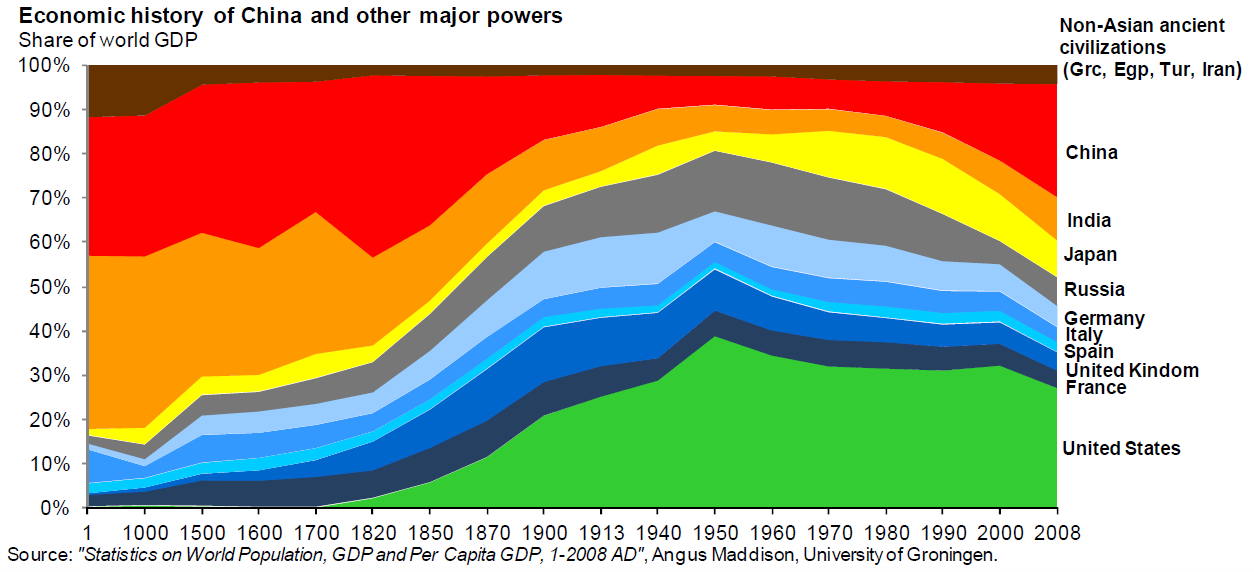
The West has long enjoyed global supremacy. Beginning in the late 18th century, the Industrial Revolution — followed by a series of further technical revolutions — enabled Britain and France, then Germany and the US, to eclipse the economic might of the ancient eastern powers of China and India.
Fig.16: Global GDP 1AD — 2008
The roots of western supremacy can be traced back to the upheavals of the early 19th century, which shook Europe to its core. As in the East, war played a defining role in shaping the western approach to strategy. Before the French revolution (1789-99), many believed that war, though a chaotic force, could ultimately be controlled. With sufficient “hard, quantifiable data” warfare would become “a branch of the natural sciences, a rational activity from which the play of chance and uncertainty [could be] entirely eliminated."1 This optimistic reasoning, typical of the Enlightenment, was called strategy — a term that started to become widely used in Europe. The hope was that strategy could calculate away the many inconveniences of war — such as too much bloodshed — making it a more civilised alternative for resolving disputes between nations whenever the tricky game of diplomacy broke down.
The brutal violence of the Napoleonic wars destroyed these illusions of an orderly, gentlemanly pursuit of war. Europe’s most eminent thinkers were forced to think again.
“The Fascinating Trinity”
Carl von Clausewitz (1780-1831) was a Prussian officer with first-hand experience of how modern warfare “had broken loose in all its elemental fury."2 He had fought with the Russians against Napoleon’s forces at Borodino — the largest and bloodiest battle of the Napoleonic wars — a day of such overwhelming carnage and confusion that it defied calculation. And he dedicated his life trying to understand and explain the complexities of this violent new world in his seminal work ‘On War’ (Vom Kriege). One of his most significant contributions was the “fascinating Trinity” (Wunderliche Dreifaltigkeit), which described the three interacting forces driving warfare:
- Emotion: Primordial violence, hatred and enmity — a blind, irrational but natural force
- Reason: The pursuit of rational aims and subordination of emotion into rational policies
- Chance: The unpredictable play of probability where the creative spirit is free to roam.
Fig.17: Clausewitz’s “Fascinating Trinity”
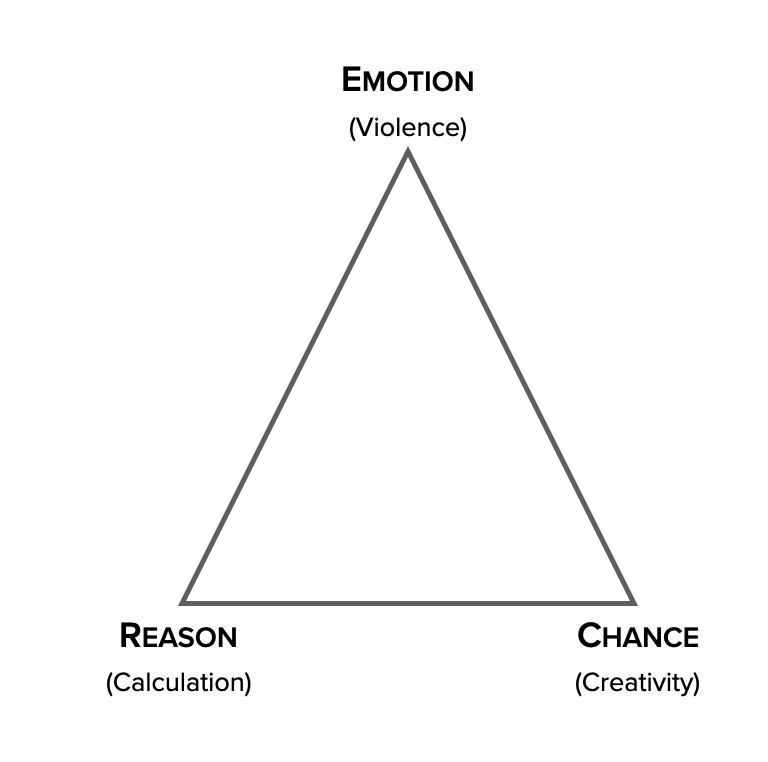
To Clausewitz, war was an interplay of emotive violence, calculating strategy and unexpected chance. Each point of his Trinity exerts a magnetic pull, creating a ‘centre of gravity’ (Schwerpunkt) for each belligerent. This is key to their ability to wage war. For one belligerent, the ‘centre of gravity’ may be shaped more by their people’s irrational aggression and hatred; for another, this primordial element is subordinate to calculated policies and rational decisions; while all belligerents are subject to the vagaries of chance. The ‘centre of gravity’ can be both a core strength, or the greatest vulnerability, for if overwhelming force can be directed at the enemy’s Schwerpunkt, it can cripple their ability to fight.
Clausewitz was clear that “physical force … is thus the means of war; to impose our will on the enemy is its object. To secure that object we must render the enemy powerless; and that, in theory, is the true aim of warfare."3 He argued that “the ideal strategy was to identify the enemy’s centre of gravity and then to direct all one’s energies against it; and if the centre of gravity proved to be the opposing army, so much the better.”4 Achieving this decisive outcome required a formidable military machine — one armed with the latest weapons, supported by sound tactics, disciplined troops, impeccable logistics and effective communication to command and control activities. Clausewitz argued that the military should always be subordinate to the government — to ensure war served rational political objectives — but, once war had been declared, the military machine should be unleashed to its fullest extent and deployed with maximum force. There should be no half-measures — war, at least in theory,5 should be ‘absolute’.
Friction
Clausewitz’s position was that a powerful military machine was crucial for delivering total victory. But he also knew, from first-hand experience, that “everything in war is very simple, but the simplest thing is difficult”. He had observed how “countless minor incidents — the kind you can never really foresee — combine to lower the general level of performance, so that one always falls short of the intended goal."6 He called this accumulation of unpredictable events friction. Incidents, such as a misfiring weapon, troops taking a wrong turn, or unseasonable rain bogging down a cavalry charge combine to make war chaotic and unpredictable. Friction transforms war into a non-linear, multi-dimensional phenomenon that defies analysis or prediction and can prevent leaders from fully achieving their objectives.
Clausewitz maintained that the complexity and unpredictability of war meant that “no other human activity is so continuously or universally bound up with chance."7 Yet chance — the third pillar in his ‘fascinating trinity’ — remained problematical for him. He offered no clear definition of chance,beyond an uncontrollable external force that causes a metaphorical fog of war to descend on the battlefield. “Three quarters of the factors on which action in war is based are wrapped in a fog of greater or lesser uncertainty"8 meaning that “guesswork and luck come to play a great part”. Cutting through this fog, Clausewitz insisted, required a new type of leader, one with “a sensitive and discriminating judgment” and “a skilled intelligence to scent out the truth."9 The successful execution of war required a strategic genius.
Genius
In Clausewitz’s time, genius had become a “much used and abused” term. But he sought to “strip [it] of the myths that had accumulated around it."10 Influenced by the critical philosophy of his fellow Prussian, Immanuel Kant — who reasoned that man was not a passive accumulator of knowledge, but a dynamic creator who could mould a better world — Clausewitz rejected the idea of genius as a divine gift. Instead, he defined it as a “very highly developed mental aptitude for a particular occupation."11 In the military context, this meant possessing two key qualities: intuition and determination — capabilities that set the military genius apart from the ordinary commander, enabling him to navigate the uncertainties of warfare and act decisively.
When friction causes even the most well-oiled military machines to falter, lesser commanders start to question themselves, spreading anxiety and eroding the morale of those around them. But the military genius distinguishes himself through intuition — what the French call coup d’oeil — to pierce through this fog of war, immediately take in everything, and decide the right next thing to do. Through determination — a “tremendous willpower to overcome this resistance"12 — he imposes his will on a situation, fortifying the “ebbing of moral and physical strength” of those around him who have entrusted their leader “with their thoughts and feelings, hopes and fears”. Thus, through intuition and determination, does the military genius shape events on the battlefield.
***
Clausewitz’s theories profoundly influenced the 19th century Prussian army, whose decisive victories in the wars of German unification (1864-1871) demonstrated the applicability of his theories. These dramatic successes forced the rest of Europe to reckon with the Prussians’ ideas. Eventually, the belief that “strong discipline, good weapons, appropriate elementary tactics, good march dispositions, railways, practical supply arrangements and communications determine everything in war"13 became widely accepted across the continent. Yet, as friction meant that “no plan of operations extends with any certainty beyond the first encounter with the main enemy forces",14 it was also accepted that victory depended on that most elusive of qualities: genius.
Ironically, as he had fought against him on the battlefield, Clausewitz’s work helped elevate Napoleon as the embodiment of the western military genius. Successive generations of leaders sought to emulate the Corsican, relying on intuition to identify the battle’s ‘decisive point’ and exhibiting iron determination to “concentrate everything available against it, stripping forces from secondary fronts and ignoring lesser objectives [as] this had been the secret of Bonaparte’s success.”15 This strategic approach underpinned European supremacy in the 19th century. But it also sowed the seeds of its eventual downfall. The outbreak of the Great War in 1914 saw equally powerful military machines deploy ‘maximum force’ to ‘cripple’ their opponents, ultimately destroying European empires and an entire generation of its people.
Conclusion
Western primacy over the last two centuries owes much to the combined forces of Clausewitz’s strategic theories and European Industrial Revolutions. These emphasised the accumulation of military power to impose one’s will on the enemy, and provided the technical and industrial capacity for delivering it. Yet, it was also Clausewitz’s concept of friction — the element separating real war from war on paper — that influenced the western approach to strategy.
The fog of war that descends on the battlefield creates widespread uncertainty, making troops “apprehensive if not actually physically frightened."16 Amid the extreme violence and chaos of war, logical calculations matter less than the “vital but incalculable factor of morale."17 Commanders must act quickly to identify the ‘centre of gravity’ and launch their full force at it in an attempt to collapse their enemy’s morale and resistance before their own falters. Ultimately, the key factor in the western approach to strategy — the difference between victory and defeat — became the strategic genius who could sustain belief amongst his forces long enough for his amassed military might to prevail.
The fog of war that descends on the battlefield creates widespread uncertainty, making troops “apprehensive if not actually physically frightened."16 Amid the extreme violence and chaos of war, logical calculations matter less than the “vital but incalculable factor of morale."17 Commanders must act quickly to identify the ‘centre of gravity’ and launch their full force at it in an attempt to collapse their enemy’s morale and resistance before their own falters. Ultimately, the key factor in the western approach to strategy — the difference between victory and defeat — became the strategic genius who could sustain belief amongst his forces long enough for his amassed military might to prevail.
1 Clausewitz. A very short introduction. Michael Howard 2002 p13
2 On War, book 8, chapter 3
3 ibid., chapter 1
4 Clausewitz. A very short introduction. Michael Howard 2002 p40
5 But in practice, political and practical considerations place limits on how the war is conducted.
6 On War, book 1, chapter 7
7 ibid., book 1 chapter 1
8 ibid., book 1, chapter 3
9 ibid., book 1 chapter 1
10 Clausewitz. A very short introduction. Michael Howard 2002 p27
11 On War, book 1, chapter 3
12 ibid., book 1, chapter 3
13 Clausewitz. A very short introduction. Michael Howard 2002 p62
14 As Helmuth von Moltke — a disciple of Clausewitz and Chief of the German General Staff — later famously declared
15 Clausewitz. A very short introduction. Michael Howard 2002 p42
16 ibid., p26
17 ibid., p27